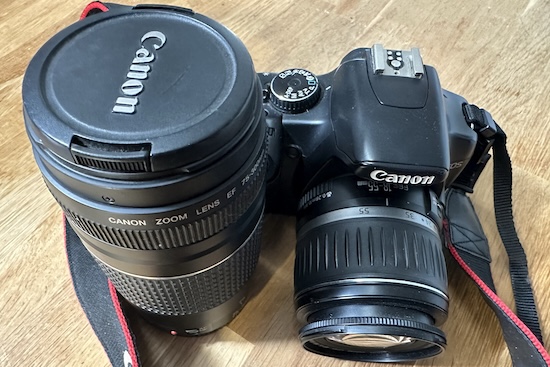
For my daughter, I found a small Canon 450D with two lenses in July 2026 for less than €80 on the used market: there is no need to blow the budget to learn photography.

How to Choose a Camera Body? (last updated August 19, 2026)
Today, the choice is essentially between mirrorless cameras and the used DSLR market. Mirrorless cameras have gradually replaced DSLRs in the new product ranges of the main manufacturers, while offering an electronic viewfinder, very capable autofocus and often more compact bodies. The choice of camera body mainly depends on your budget, sensor format, autofocus, ergonomics and the lenses available.
For my daughter, I found a small Canon 450D with two lenses in July 2026 for less than €80 on the used market: there is no need to blow the budget to learn photography.
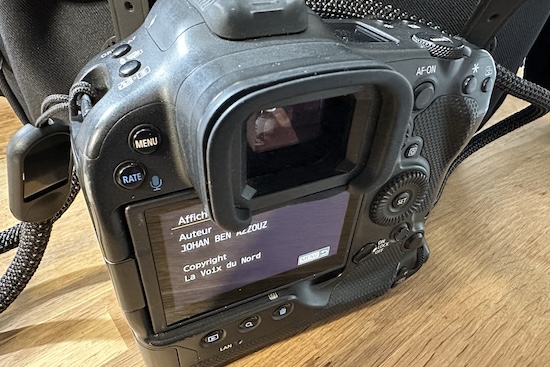
For my work as a photojournalist, my employer, La Voix du Nord, provides me with a Canon R3: a high-end, robust camera designed for very intensive use.
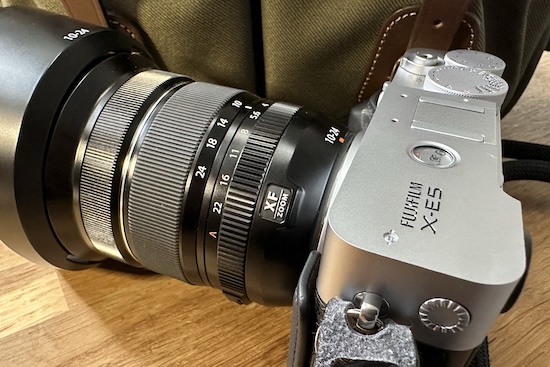
Outside work, I use this small Fujifilm APS-C camera with its vintage look, the X-E5: light, capable and very good-looking! I use it with a wide-angle lens and a telephoto lens.
A DSLR uses a mirror and an optical viewfinder: this technology is no longer at the heart of the new product ranges from the major manufacturers. A mirrorless camera has no mirror and uses an electronic viewfinder. It can display the exposure, white balance and certain settings directly in the viewfinder, while also making subject-tracking autofocus easier.
For a new purchase, a mirrorless camera is now the most logical choice if you want to invest in a system that is expected to evolve. DSLRs are still very attractive on the used market, however: there is a huge range of Canon EF, Nikon F and other DSLR-mount bodies and lenses, often available at very affordable prices.
Sensor size affects framing, depth of field, noise performance and the size of the camera body and lenses. The three most common formats are full frame, APS-C and Micro Four Thirds.
Full frame 24×36
It uses the dimensions of the 35mm film format. It offers good high-ISO performance and makes it possible to achieve shallower depth of field at comparable framing and aperture. It is found in many enthusiast and professional camera bodies. Canon, for example, offers the Canon EOS R6 Mark III, while Nikon offers the Nikon Z6 III and Sony the Sony Alpha 7 V.
APS-C format
Smaller than full frame, it allows manufacturers to design more compact and often less expensive bodies and lenses. The crop factor is approximately 1.5× for Nikon, Sony and Fujifilm, and 1.6× for Canon. A 200mm lens therefore gives an angle of view comparable to a 300mm lens on full frame with 1.5× APS-C systems, or 320mm with Canon.
Canon offers the Canon EOS R7, an APS-C body that is particularly interesting for sports and wildlife, while Nikon offers the Nikon Z50 II, a versatile APS-C model. Fujifilm is also particularly strong in this format with its X series. The Fujifilm X-E5, for example, is a compact APS-C body that allows for a lightweight setup while maintaining good image quality. It is a particularly interesting format for photographers looking for a compromise between size, image quality and lens choice.
Micro Four Thirds
Even smaller, Micro Four Thirds uses a 2× crop factor. Its main advantage is very compact bodies and, above all, very compact lenses, with a wide choice of telephoto lenses. It remains interesting for travel, hiking, wildlife or any type of photography where equipment weight matters.
Notable examples include the OM System OM-1 Mark II, a body strongly oriented towards action and wildlife photography, and the Panasonic Lumix G9 II. Both remain current reference models in the Micro Four Thirds format.
Medium format
Larger than full frame, medium format offers very high resolution, a wealth of detail and a distinctive rendering, particularly thanks to the larger sensor. It is mainly aimed at photographers who prioritize image quality and large prints over compactness and speed.
Fujifilm is one of the strongest manufacturers in this market with its GFX range. The Fujifilm GFX100S II, for example, combines a 102-megapixel medium-format sensor with a relatively compact body for this category. It is a particularly interesting solution for landscapes, portraits, fashion and commercial photography.
Choosing a brand today depends as much on the ergonomics of the body as on the range of lenses and accessories available. Canon, Nikon and Sony offer very comprehensive mirrorless systems, while Fujifilm is particularly strong in APS-C and medium format. OM System remains an interesting Micro Four Thirds alternative. The used market broadens the choice even further, particularly with older DSLR mounts.
There is no single brand that is better than all the others: what matters most is choosing a system you feel comfortable using. Grip, control layout, viewfinder, autofocus and the weight of the body-and-lens combination are often more important than differences in specifications.
The camera body is important, but don't forget the lens and the system as a whole. An excellent body fitted with a mediocre lens will not necessarily produce better results than a simpler body paired with good glass.
With a limited budget, it can therefore make sense to devote a significant part of it to lenses. The body can be replaced later, while good glass can remain in your bag for many years. Conversely, if you shoot sports, photojournalism or wildlife, autofocus, burst shooting, high-ISO performance and body ergonomics can justify a larger investment.
Resolution
The number of pixels determines the file resolution. For most uses, 24 megapixels are more than enough for web publishing, high-quality prints and reasonable cropping. Higher resolution becomes useful for very large prints and significant crops.
ISO sensitivity
The ability to keep an image clean as light levels fall is particularly important in photojournalism, concerts, indoor photography, sports and wildlife. Don't look only at the advertised maximum ISO: the actual quality of the file at high sensitivity is more important.
Burst mode
A high frame rate is useful for sports, wildlife and certain action scenes. But maximum speed is not everything: the camera's ability to maintain autofocus, burst duration and buffer management are also important.
Autofocus (AF)
Recent mirrorless cameras feature autofocus systems capable of automatically detecting and tracking people, animals, vehicles and other subjects. For sports and photojournalism, tracking performance is often more important than the sheer number of focus points.
Other factors to consider include body weight, memory-card type and capacity, build quality, battery life, stabilization, video features, the quality of the electronic viewfinder and screen, and overall ergonomics.
| Price | Cameras to consider |
| Under €500 | For new cameras, the choice mainly consists of small entry-level APS-C mirrorless models, depending on promotions. On the used market, there are many older DSLRs and mirrorless cameras: Canon EOS 2000D, 250D, 400D, 450D, Sony A6000/A6100, Nikon D5600 or Fujifilm X-T30, for example. |
| €500 to €1,000 | Canon R50 or R10, Nikon Z50 II, Sony A6400/A6700 depending on offers, Fujifilm X-S20 or X-T30 II depending on your budget. The used market also gives access to older full-frame bodies. |
| €1,000 to €2,000 | Canon R7 or R8, Nikon Z5 II or Z6 III depending on promotions, Sony A7 III/A7 IV depending on the market, Fujifilm X-T5 or X-S20. This is a price range where you can find excellent enthusiast bodies, both APS-C and full frame. |
| Over €2,000 | Canon R5 Mark II, R6 Mark III, R3 or R1 depending on your needs, Nikon Z8/Z9, Sony A7R V, A9 III or A1 II. For highly specialized uses, the Fujifilm GFX range and certain high-resolution bodies go even further. |
If your budget is very limited, consider the used market. It gives you access to enthusiast or professional bodies that are still perfectly usable today, particularly for photojournalism. Older generations of Canon, Nikon or Pentax DSLRs can be an economical solution, provided you check the condition of the body, shutter count, battery and availability of accessories.
For someone starting today with a system that is expected to evolve, I would nevertheless favour a recent mirrorless camera if the budget allows. Choosing a current mount lets you gradually build a collection of lenses without starting from scratch when you next replace the body.
For example, in July 2026 I recently found a Canon EOS 450D for my five-year-old daughter, together with two lenses, an 18-55mm and a 75-300mm, for just €80 for the whole kit. The lenses are certainly entry-level models, but this is perfectly suitable equipment for learning photography without blowing the budget. The body dates from 2008, so it is more than 18 years old today, showing that an older camera can still make a lot of sense when bought at the right price. Canon documents the EOS 450D as a 2008 model.
Obviously, you cannot expect the autofocus, burst-shooting or high-ISO performance of a recent mirrorless camera. But for learning the basics — framing, exposure, depth of field and using a lens — the value for money of such a used kit is hard to beat.
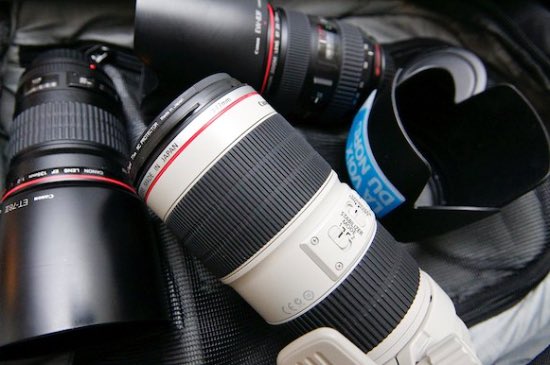
How to choose a lens?
The lens is the component that has the greatest impact on image sharpness [...]
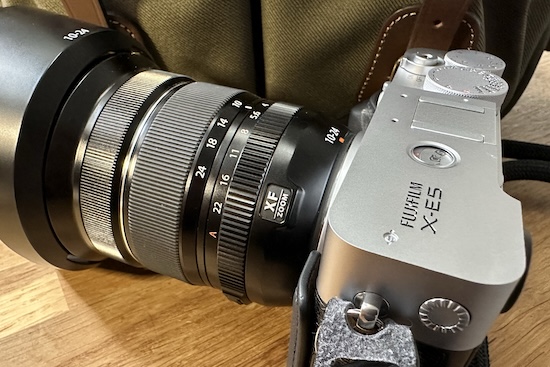
How to choose a camera?
Today, the choice is mainly between mirrorless cameras and the used market [...]
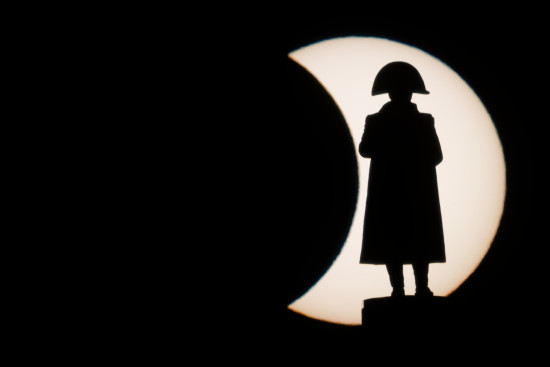
How I photographed Napoleon during the solar eclipse?
An image like this does not happen by chance [...]

How I set up my camera
There is obviously no universal setting that works for every situation. The choices [...]
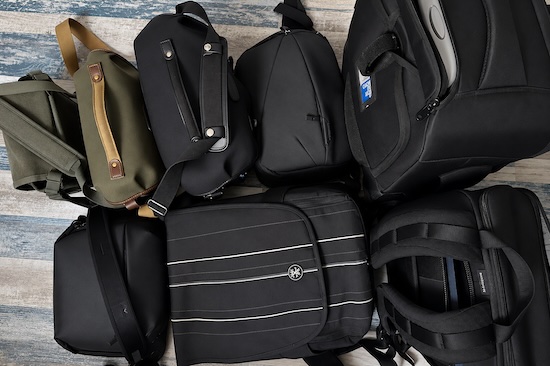
How to choose a camera bag
Finding the perfect camera bag to carry and protect your valuable equipment is [...]

How to choose a computer?
Clearly, in 2026, any recent laptop or desktop computer, whether PC or Mac, can [...]
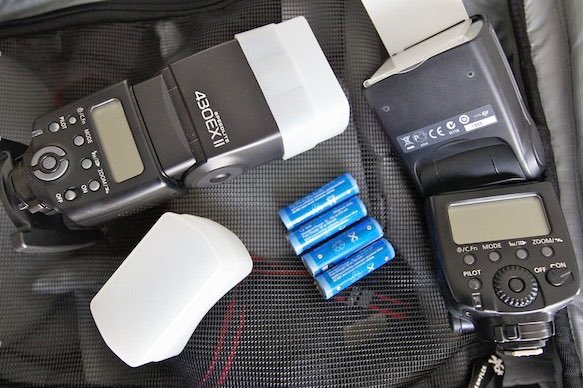
How to choose a speedlight?
A speedlight is far from essential for taking good photographs. Recent cameras [...]
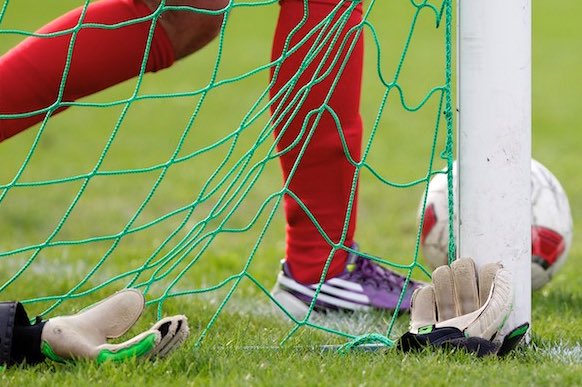
Photographing amateur football
For those getting started in sports photography, covering an amateur football match is a good choice [...]
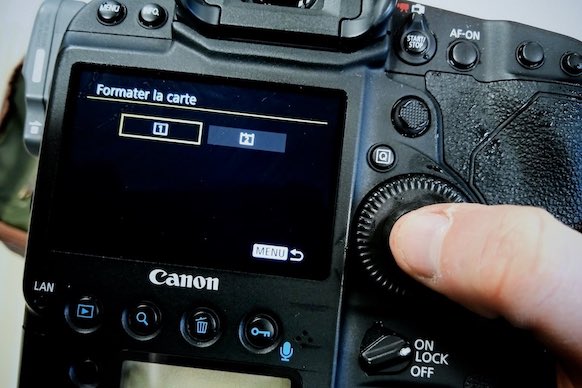
Recovering deleted photos
Accidentally deleting the contents of a memory card by formatting it can happen to anyone: don't panic [...]
My workflow with DxO and Photo Mechanic
Why I spend less than a minute (per photo) on post-processing my assignments [...]

Photographing sports
Sports photography is quite a challenging field to master. It requires [...]

Getting press accreditation
Press accreditation is the essential pass that allows you to photograph a concert, event [...]

Photographing a concert
Photographing a concert or show is relatively complex, but very rewarding [...]
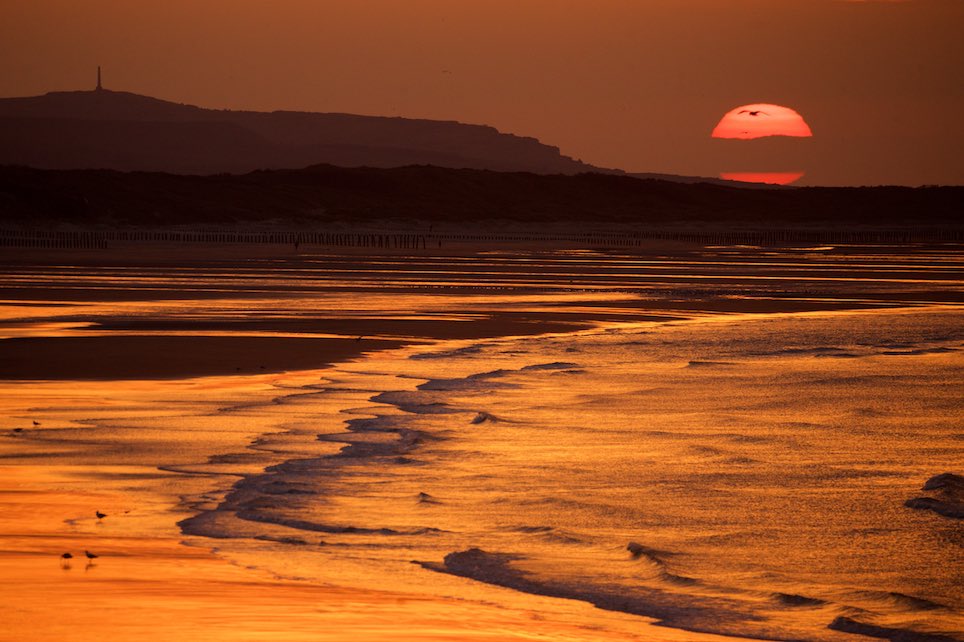
Photographing a sunset
Photographing a sunset is a real treat for both the eyes and the photographer, impossible to [...]
10 tips for better photos
A few tips, in no particular order, to avoid common mistakes. The very first tip [...]

How to create a panning effect?
Essential for photographing motorsports such as rallies, F1 or [...]
Photography in the rain
As I live in Pas-de-Calais, I should have some expertise when it comes to answering this [...]
Photography basics
When taking a photograph, the photographer can adjust four parameters to compose and control [...]