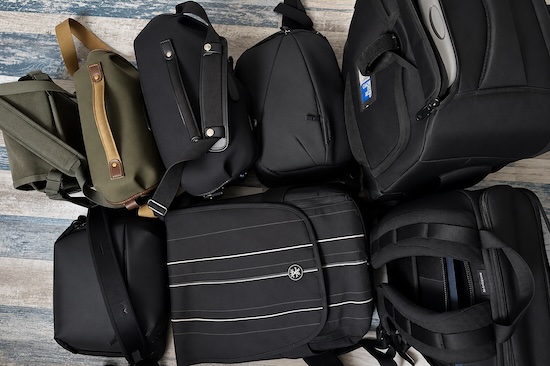
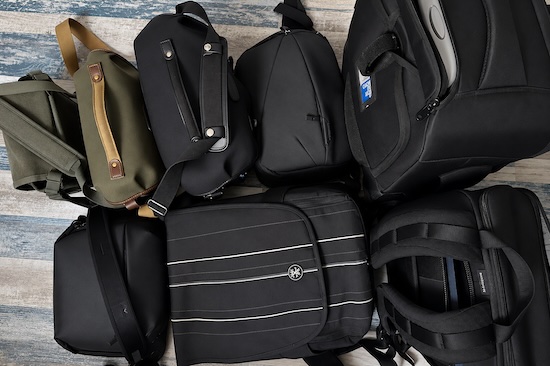
A large part of my camera bag collection (Billingham, Think Tank, Peak Design, NEEWER): my wife regularly makes fun of me because I somehow ended up with more camera bags than she has handbags…

How to choose the right camera bag? (last updated August 20, 2026)
Finding the ideal camera bag to carry and protect your precious gear can sometimes be a real challenge! Depending on the type of assignment and therefore the gear you need to take with you, one bag may be better suited than another. In the end, it is not necessarily about finding one camera bag, but rather several, each suited to a particular situation.
A large part of my camera bag collection (Billingham, Think Tank, Peak Design, NEEWER): my wife regularly makes fun of me because I somehow ended up with more camera bags than she has handbags…
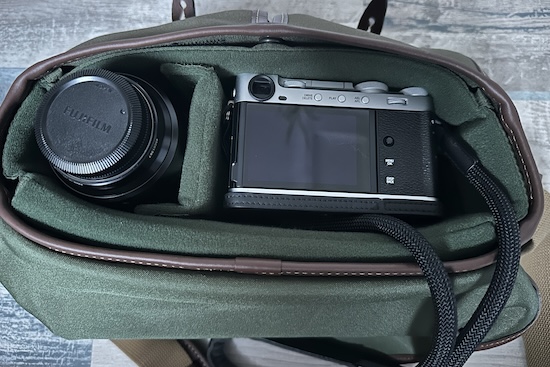
A look inside a Billingham Hadley Small Pro. I carry my Fujifilm X-E5 with a 10-24mm f/4 wide-angle lens and a 50-140mm f/2.8. It is very comfortable, especially with the optional shoulder pad.
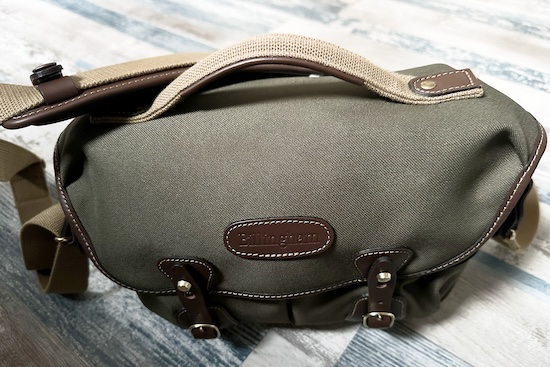
And here is the outside of my Billingham Hadley Small Pro, in sage/chocolate Fibrenyte, which I find very elegant and exceptionally well made. I use this one mainly for leisure, never for work.
This type of bag is the most common and often the most comfortable. It offers plenty of carrying capacity and there is a huge choice in shops and online, with something for every taste and budget. Basic models typically hold a camera body and two or three additional lenses.
The larger backpacks can hold several professional camera bodies and lenses, including a 400mm or 500mm lens, as well as a laptop and a tripod or monopod. The backpack does have one major drawback: access to your gear is not particularly quick, and you often have to put the bag down to use your equipment. One way around this is to choose a bag with a single shoulder strap that can be swung around to access your gear, although the weight is then distributed less evenly across your shoulders.
When choosing a backpack, check its internal height carefully, especially if you use a DSLR with a battery grip or a professional camera body. Also beware of bags that look too obviously photographic: thieves are not stupid, and a brand-new Lowepro ProTactic rarely contains nothing more valuable than food and water!
Brands worth looking at: Lowepro, Think Tank, Manfrotto, Vanguard, Tenba, Shimoda Designs and Wandrd.
This is the classic reporter’s bag: it gives you excellent access to your gear and therefore makes you highly responsive. If you do not carry much gear, a shoulder bag can easily be your only camera bag; after that, it is simply a matter of personal preference. The main drawback is… back pain over longer periods.
Brands worth looking at: Billingham (série Hadley), Peak Design (Everyday Sling),
Domke (séries F and J),
Think Tank (Randrospective 4, 7, 10, 20, 30),
National Geographic / Manfrotto (NG E2 2360, NG E2 2370, NG E2 5168),
Lowepro (ProTactic III, Nova AW II, Magnum AW).
After several years using Think Tank and then Peak Design bags, I now use several Billingham bags from the Hadley range. It is an English brand whose bags have been made in England since 1973, and I particularly like their build quality, discretion and timeless design.
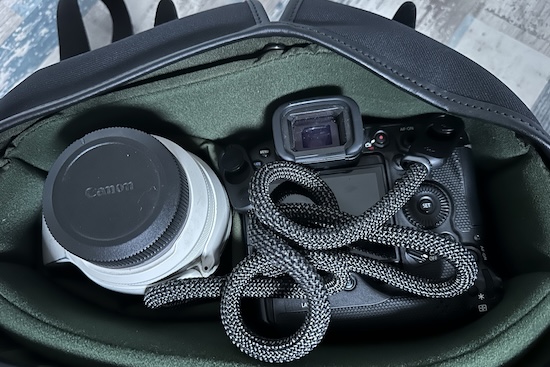
In my Billingham Hadley Pro 2021, I currently carry a Canon R3 with an RF 14-35mm and an RF 100-500mm. This is the setup I mainly use for my Canon gear (as part of my work as a photojournalist at La Voix du Nord).
For my Fujifilm gear (for personal use / holidays), I use an X-E5 with an XF 10-24mm f/4 and an XF 50-140mm f/2.8, which I carry in a Billingham Hadley Small. It is a more compact setup, but it allows me to cover quite a few situations while keeping the size and weight down.
The principle remains the same: choose your bag according to the gear you are actually taking with you and the type of assignment or trip you have planned.
On the right is my Billingham Hadley Pro: I carry a Canon R3 with an RF 14-35mm L mounted, and an RF 100-500mm L standing upright on the left-hand side. It is very comfortable, especially with the optional shoulder pad. It is also very discreet and does not attract unwanted attention.
Robust and spacious, this is the ideal solution for a sports photographer carrying a large amount of gear from one stadium to another. For air travel, few things offer better protection than a rugged Peli case. This is therefore a very specific solution: it is heavy, bulky and expensive (several hundred euros).
For football (RC Lens a few years ago, and now more often Boulogne (L2) and Dunkerque (L2)), I use this NEEWER rolling case in particular. It is relatively affordable and quite practical for transporting a large amount of gear. I can fit an RF 100-300mm f/2.8, a Canon R3, a wide-angle lens, my computer, a seat and a monopod in it. It is obviously much bulkier than a regular bag, but for football matches where I need to carry all this equipment, the wheels are a real advantage.
Brands worth looking at: Think Tank, Peli, Lowepro and NEEWER.
As its name suggests, this is a bag that opens from the top. It is useful when you only need to carry one camera body with a lens attached. It can be carried over the shoulder, by hand, on a belt, or with a chest harness. Key brands: Lowepro, Think Tank, Vanguard, Kata, Crumpler, Tamrac, Manfrotto
Not particularly discreet and limited in capacity, a belt bag offers very quick access to your gear. It can be a practical solution if you are already carrying a backpack with your personal belongings or a baby carrier. Key brands: Lowepro, Think Tank, Kata
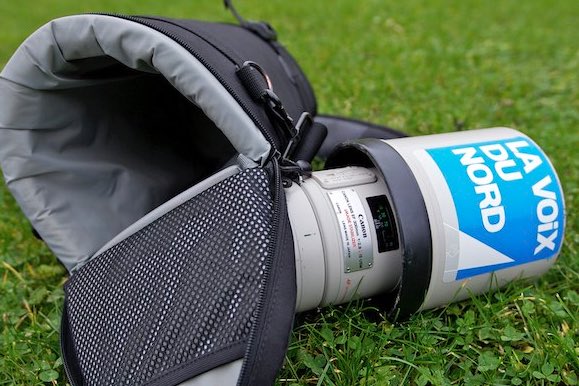
Designed to carry a single lens, a lens case is particularly useful for large telephoto lenses. It usually comes with a shoulder strap and can be carried over the shoulder, while smaller models can often be attached to a belt or directly to certain bags. It is an interesting solution for carrying a lens separately from the rest of your gear, especially when you want to stay light and responsive in the field.
For a short assignment involving a large telephoto lens, it can be very practical to carry your camera body and a few lenses in a shoulder bag and keep the telephoto in its own case. Once you arrive on location, the case can stay in the car and the telephoto lens can go straight over your shoulder. This allows you to be much more mobile than with a large backpack.
There are many current options: Lowepro, for example, offers its ProTactic LCS III range in several sizes depending on the lens. The LCS 12×24 III has an internal diameter of 12 cm and a height of 24 cm, while the LCS 13×32 III is designed for much larger lenses. These cases feature dual-density foam and the SlipLock attachment system.
Cases and pouches are also available from Think Tank, Vanguard, Manfrotto or K&F Concept, particularly through major specialist retailers and marketplaces. The advantage is that you can choose a model that matches the exact diameter and length of your lens rather than choosing a case that is too large or too small.
On the left, an old Lowepro Lens Case 5 and a Canon 300mm f/2.8 lens.
Brands worth looking at: Lowepro, Think Tank, Vanguard, Manfrotto, K&F Concept
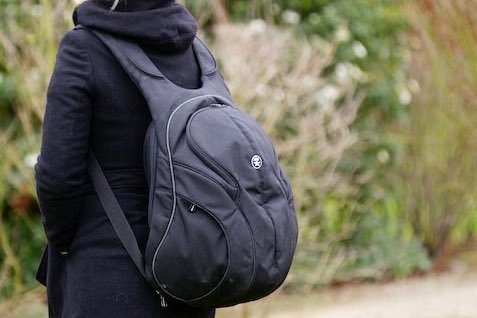
A Crumpler Italian Connection backpack: its main advantage is that it does not look like a camera bag. It can hold a 15-inch laptop, two professional camera bodies, a 70-200mm, and a 16-35mm or 24-70mm wide/standard zoom, along with various bits and pieces (charger, card reader, etc.).
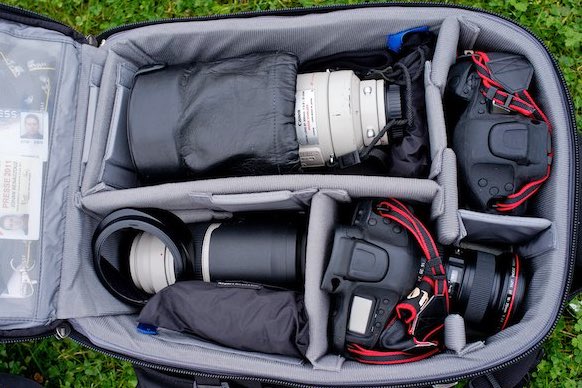
A Think Tank Airport International case: the ideal tool for covering a football match or travelling by plane. It can hold two professional camera bodies, a 300mm or 400mm f/2.8, a 16-35mm, a 70-200mm, a 15- or 17-inch laptop, as well as numerous accessories and documents.
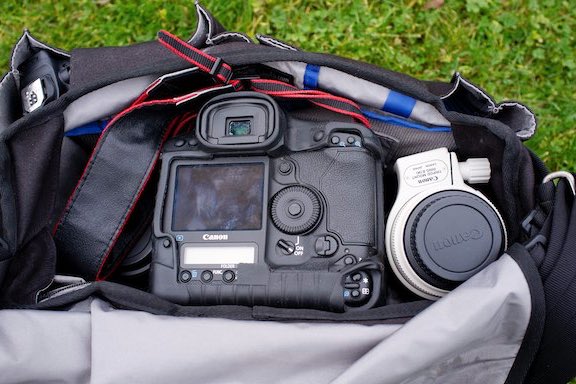
A shoulder bag, here the Think Tank Retrospective 30: this was my favourite everyday bag for several years. Its main advantage is that it does not look like a camera bag, so it does not attract unwanted attention and allows me to remain discreet.
The weight and size of the bag (is it suitable as cabin baggage when travelling by plane?), its internal capacity (especially if you use a battery grip and fast lenses), the modularity of the compartments, resistance to rain and sand (water-resistant fabric, external rain cover), carrying comfort (strap width, harness, breathable back panel), and whether it has a tripod or monopod holder. Looks also matter: I do not like bags that look too obviously photographic or video-oriented. They immediately signal that their owner is carrying expensive equipment and can therefore attract unwanted attention: in my opinion, it is practically an invitation to steal. A discreet bag that looks more like a regular bag than a camera bag makes you much less identifiable as a photographer. Finally, check whether the bag you choose has space for personal items such as your phone, documents, a GPS, or even a small bottle of water.
There is no do-it-all camera bag : if you have to choose just one bag, you will unfortunately have to make compromises. And if you are wondering how many camera bags you actually need… I am probably a very bad example: I have almost ten!
As for Billingham, I use a Hadley Pro 2021 and a Hadley Small. I have also kept several Think Tank bags, including the Randrospective 4 and 30, as well as Peak Design Everyday Slings in 6 L and 10 L. And for football, I use a NEEWER rolling case, which is much better suited to carrying a large amount of equipment without wrecking my back.
In short, buying a shoulder bag and a backpack can be a very good compromise to start with, but over time it is surprisingly easy to end up with a bag for every situation! And my wife regularly makes fun of me because I somehow ended up with more camera bags than she has handbags…
| Situation | My preferred bag | Typical gear | Why? |
| Portrait / company visit | Shoulder bag | Camera + 2 lenses | Light, discreet and immediate access |
| News / short assignment | Shoulder bag | Camera + 2 or 3 lenses | Very quick access |
| Concert | Shoulder bag or small bag | Camera + telephoto lens | Quick access and compact size |
| Hiking / long walk | Backpack | More extensive gear | Better weight distribution |
| Sports with a lot of gear | Rolling case | Several cameras + large telephoto lenses | Avoids carrying all the weight |
| Travel / air travel | Hard case | Full kit | Protection and transport |
| Light personal outing | Small, discreet bag | Camera + 2 lenses | Mobility and discretion |
But don't confuse capacity with usefulness! Je croise régulièrement des photographes, notamment amateurs, équipés de sacs à dos XXL qui semblent parfois capables d’emporter suffisamment de gear pour partir plusieurs jours en autonomie. Chacun fait évidemment comme il veut, mais je préfère pour ma part raisonner autrement : I adapt the contents of my bag to the assignment I am going to shoot.
I don't really see the point of heading out with an extremely heavy backpack to shoot a simple portrait or visit a factory. In this kind of situation, a shoulder bag with a camera and two lenses is more than enough. It is light, discreet and, above all, gives me very quick access to my gear. This is actually the type of bag I prefer for everyday use: with my Billingham Hadley Pro, I can change lenses in less than 10 seconds and be ready to shoot again immediately.
For me, the right camera bag is therefore not the one that lets you carry the most gear, but the one that lets you carry exactly what you need. There is no point taking the whole car when a bottle of water will do!
A bag capable of carrying three cameras, five lenses and a laptop may look attractive on paper. But if you have to carry it for several hours, the weight can quickly become a problem. A more compact bag will force you to make choices, but you will gain comfort, mobility and often discretion.
For me, the best camera bag is therefore the one that matches the gear I actually need and the assignment I am covering. It is better to have several bags suited to different situations than one model that is supposed to do everything. That is also why I prefer to adapt my bag to the assignment rather than trying to fit all my gear into a single bag.
Price obviously matters, but it should not be the only criterion. Build quality, carrying comfort, quick access to your gear, discretion, weather resistance and the ability to organise your equipment properly are just as important. A more expensive bag is not necessarily better suited to the way you work.
A few links to manufacturers to wrap things up: Billingham, Think Tank, Peak Design, Lowepro, Manfrotto,Domke, Crumpler, Pelicase, Neewer, Wandrd!, and Shimoda.
How to choose a lens?
The lens is the component that has the greatest impact on image sharpness [...]
How to choose a camera?
Today, the choice is mainly between mirrorless cameras and the used market [...]
How I photographed Napoleon during the solar eclipse?
An image like this does not happen by chance [...]
How I set up my camera
There is obviously no universal setting that works for every situation. The choices [...]
How to choose a camera bag
Finding the perfect camera bag to carry and protect your valuable equipment is [...]
How to choose a computer?
Clearly, in 2026, any recent laptop or desktop computer, whether PC or Mac, can [...]
How to choose a speedlight?
A speedlight is far from essential for taking good photographs. Recent cameras [...]
Photographing amateur football
For those getting started in sports photography, covering an amateur football match is a good choice [...]
Recovering deleted photos
Accidentally deleting the contents of a memory card by formatting it can happen to anyone: don't panic [...]
My workflow with DxO and Photo Mechanic
Why I spend less than a minute (per photo) on post-processing my assignments [...]
Photographing sports
Sports photography is quite a challenging field to master. It requires [...]
Getting press accreditation
Press accreditation is the essential pass that allows you to photograph a concert, event [...]
Photographing a concert
Photographing a concert or show is relatively complex, but very rewarding [...]
Photographing a sunset
Photographing a sunset is a real treat for both the eyes and the photographer, impossible to [...]
10 tips for better photos
A few tips, in no particular order, to avoid common mistakes. The very first tip [...]
How to create a panning effect?
Essential for photographing motorsports such as rallies, F1 or [...]
Photography in the rain
As I live in Pas-de-Calais, I should have some expertise when it comes to answering this [...]
Photography basics
When taking a photograph, the photographer can adjust four parameters to compose and control [...]