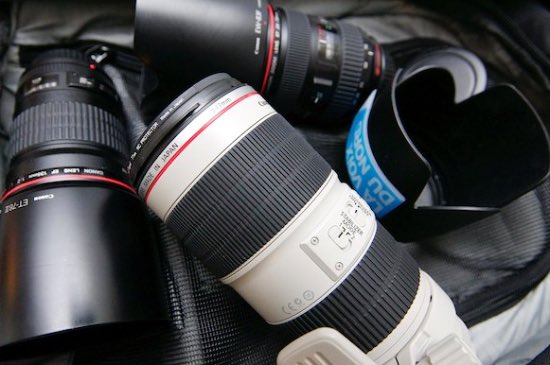
A Canon 70-200 f/2.8 IS II with a 77mm protective filter and its lens hood.

How to Choose a Lens (last updated August 19, 2026)
The lens (or “glass”, as photographers sometimes call it) is the component whose quality has the greatest impact on the sharpness of a photograph (detail, contrast and definition). It is characterized by its focal length (in mm), aperture (maximum brightness) and angle of view (compatibility with a full-frame sensor or a smaller APS-C/DX sensor). There is a huge range of lenses available, and choosing one or more depends on the type of photography you want to do (sports, landscapes, family photos, photojournalism…) and, of course, your budget. You should expect to spend at least €400 for a good lens (for example, a 50mm f/1.4).
One rule to remember: it is always better to use a good lens with a budget camera body than the other way around, so put your money into your lens or lenses. Unlike camera bodies, whose technology evolves very quickly, a lens is a long-term investment and is much less affected by obsolescence.
A Canon 70-200 f/2.8 IS II with a 77mm protective filter and its lens hood.
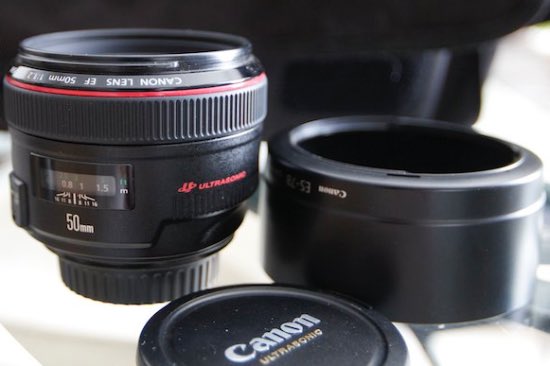
Canon 50mm f/1.2 L. Canon’s high-end L series can be recognized by the red ring around the barrel.

A Canon 300mm telephoto lens with an f/2.8 aperture. Its high light-gathering capability makes it heavy and bulky!
Expressed in millimetres, focal length is the distance between the camera sensor (24 × 36 mm format) and the optical centre of the lens. Focal length affects the magnification of the subject and the angle of view. The shorter the focal length, the wider the angle of view. A 16mm wide-angle lens therefore provides a very broad field of view, while a 400mm telephoto lens produces a very narrow angle of view for close-up framing. There are two categories of lenses: prime lenses with a fixed focal length and variable-focal-length lenses, known as “zooms”. For example, a Canon 24-105 f/4L has a focal length ranging from 24mm (wide angle) to 105mm (short telephoto), giving a 4.3x zoom range (105mm/24mm). A zoom is often more practical, especially when you cannot move around the subject, although a prime lens will generally offer better image quality.
Lens focal lengths are specified for a 24×36 sensor (film SLRs or high-end digital cameras such as the Canon R3 and R6, or the Nikon Z8 and Z9). On most digital cameras with smaller sensors, the final image is effectively magnified by a crop factor. The crop factor is 1.6x for Canon and 1.5x for Nikon.
Thus, on a Canon APS-C body (for example the R7, R8 or an older 7D), a 200mm lens effectively becomes 200×1.6, or 320mm. This is a clear advantage for users of long focal lengths (sports and wildlife), but a major disadvantage for wide-angle enthusiasts: a 14mm lens effectively becomes a 22mm equivalent.
This is the maximum amount of light the lens can transmit when the diaphragm is fully open. The maximum aperture is determined by the diameter of the front element and the focal length according to the formula Aperture = focal length / front element diameter. Thus, a 200mm Canon lens with a 72mm front element has an aperture of 200 / 72 = 2.77, and the Canon 200mm L indeed has an f/2.8 aperture. This explains why aperture varies on most zoom lenses: a Canon 70-300mm f/4.5-5.6 has an aperture of f/4.5 at 70mm and f/5.6 at 300mm.
High-end zoom lenses offer a constant aperture regardless of the focal length used (by stopping the diaphragm down at the wide-angle end). For example, with a Canon 70-200 f/2.8, the front element is 77mm in diameter, which would theoretically give a maximum aperture of 200 / 77 = 2.59 at 200mm and 70 / 77 = 0.90 at 70mm. To maintain a constant f/2.8 aperture, the manufacturer uses only 25mm (70 / 2.8) of the front element diameter at 70mm, 48mm (135 / 2.8) at 135mm, etc. This is a complex and costly technology that gives photographers great flexibility. If your budget allows, this type of lens is worth prioritizing.
For the brightest lenses, the standard maximum aperture values are f/1.2, f/1.4, f/1.8, f/2 and f/2.8; other lenses commonly start at f/4, f/5.6 or f/6.3.
One rule to remember: the lower the number, the more light the lens can gather — and the more expensive it tends to be.
Wide angle, 50mm, telephoto? The right lens depends on what you intend to use it for.
| Type | Possible uses |
| Wide angle | Photojournalism, nature and landscapes, concerts, events, people and everyday life |
| 50 mm | Portraits, street photography, studio work, still life, people and everyday life. A 50mm lens on a full-frame camera roughly matches the perspective of human vision. |
| Standard zoom | Versatile, photojournalism, weddings, family use. An all-purpose lens if you only want to carry one. |
| 85 mm | Portraits, weddings, studio work, close-ups |
| Telephoto zoom | Versatile for sports, wildlife, concerts and events, and weddings. A 70-200 set to 200mm, for example, can isolate a subject with a shallow depth of field. |
| Prime telephoto | Sports, portraits, wildlife, concerts and events. Better image quality than a zoom, but less flexible. |
| Fish-eye | Creative effects, perspective distortion. |
| Tilt-shift lens | Architectural photography and creative work. This type of lens can correct perspective and control depth of field. |
| Macro lens | Very close-up photography, wildlife, insects and still life. |
A lens has a diaphragm: essentially a mechanical opening whose diameter varies to let in more or less light. When we talk about aperture, we are therefore talking about the opening of the diaphragm. The maximum aperture of a lens is determined by the diameter of the front element and the focal length according to the formula Aperture = focal length / front element diameter. Thus, a 200mm Canon lens with a 72mm front element has an aperture of 200 / 72 = 2.77, and the Canon 200mm L indeed has an f/2.8 aperture. This explains why aperture varies on most zoom lenses: a Canon 70-300mm f/4.5-5.6 has an aperture of f/4.5 at 70mm and f/5.6 at 300mm.
High-end zoom lenses offer a constant aperture regardless of the focal length used (by stopping the diaphragm down at the wide-angle end). For example, with a Canon 70-200 f/2.8, the front element is 77 mm in diameter, which would theoretically give a maximum aperture of 200 / 77 = 2.59 at 200 mm and 70 / 77 = 0.90 at 70 mm. To maintain a constant f/2.8 aperture, the manufacturer uses only 25 mm (70 / 2.8) of the front element diameter at 70 mm, 48 mm (135 / 2.8) at 135 mm, etc. This is a complex and costly technology that gives photographers great flexibility.
Standard aperture values are: f/1.2, f/1.4, f/1.8, f/2, f/2.8, f/3.5, f/4, f/4.5, f/5.6, f/6.3, f/8, f/9, f/11, f/13, f/16, f/18, f/20, f/22.
Key point : Your choice of aperture directly affects depth of field (see below). Choose your aperture according to the area you want to keep sharp and the amount of light in the scene. If you need a large area of sharpness but there is very little light (at night, for example), the only solution is to mount your camera on a tripod and use a long exposure (with the shutter remaining open for several seconds).
Expressed in millimetres, focal length is the distance between the camera sensor (24 × 36 mm format) and the optical centre of the lens. Focal length affects the magnification of the subject and the angle of view. The shorter the focal length, the wider the angle of view. A 16mm wide-angle lens therefore provides a very broad field of view, while a 400mm telephoto lens produces a very narrow angle of view for close-up framing. There are two categories of lenses: prime lenses with a fixed focal length and variable-focal-length lenses, known as “zooms”. For example, a Canon 24-105 f/4L has a focal length ranging from 24mm (wide angle) to 105mm (short telephoto), giving a 4.3x zoom range (105mm/24mm). A zoom is often more practical, especially when you cannot move around the subject, although a prime lens will generally offer better image quality.
Lens focal lengths are specified for a 24×36 sensor (film SLRs or high-end digital cameras such as the Canon R3 and R6, or the Nikon Z8 and Z9). On most digital cameras with smaller sensors, the final image is effectively magnified by a crop factor. The crop factor is 1.6x for Canon and 1.5x for Nikon.
Thus, on a Canon APS-C body (for example the R7, R8 or an older 7D), a 200mm lens effectively becomes 200×1.6, or 320mm. This is a clear advantage for users of long focal lengths (sports and wildlife), but a major disadvantage for wide-angle enthusiasts: a 14mm lens effectively becomes a 22mm equivalent.
Key point: Focal length affects the magnification of the subject and the angle of view. The shorter the focal length, the wider the angle of view. As with aperture, focal length also affects depth of field (see below): to isolate a subject, such as in a portrait, use a longer focal length (85, 135 or 200mm).
Some lenses feature image stabilization: IS (Image Stabilizer) from Canon, VR (Vibration Reduction) from Nikon, OS (Optical Stabilizer) from Sigma, and VC (Vibration Compensation) from Tamron. These technologies use sensors inside the lens to detect and measure mechanical vibrations caused by the photographer. The system then compensates for these vibrations by moving a group of lens elements to stabilize the image.
Depending on the photographer and the conditions, image stabilization can provide a gain of 3 to 4 stops: for example, with a 200mm lens, you would theoretically need to shoot at 1/200 to avoid camera shake, but with stabilization active you can easily drop to 1/50 while remaining sharp. Of course, this only applies to static subjects: there is therefore little point in buying a stabilized lens specifically for sports photography, except for panning (rally, F1, Enduro du Touquet, motocross). In that case, only vertical vibration needs to be corrected. This is what Canon lens IS Mode 2 does, and it is the mode you should use for panning. On Nikon VR lenses, the type of vibration (horizontal or vertical) is detected automatically in “Normal” mode.
Every lens has a minimum focusing distance; for example, 1.20m on a Canon 70-200 2.8 L IS II. Below this distance, it is impossible to focus and obtain a sharp subject. Focusing is handled by an autofocus (AF) system. Look for lenses with ultrasonic motor autofocus, a technology that provides fast and quiet focusing: it is called USM by Canon, AF-S by Nikon, HSM by Sigma, SDM by Pentax, SWD by Olympus, and SSM by Sony.
Canon lens abbreviations (example: Canon EF 70-200 mm f/2.8 L IS USM)
| Abbreviation | Definition |
| EF | Electronic Focus. This is a Canon lens mount compatible with all Canon SLRs (since 1987), regardless of sensor size. |
| EF-S | Electro Short Back Focus : A Canon mount introduced in 2003 for APS-C cameras (7D, 550D, 60D, etc.). Incompatible with 24×36 and APS-H bodies (1D, 5D). |
| IS | Image Stabilizer : Lens equipped with an optical stabilization system. |
| L | L stands for Luxury. A Canon L-series lens is a high-end lens aimed at professionals and demanding enthusiasts. |
| USM | Ultra Sonic Motor : Lens with autofocus (AF) using a fast and quiet “Ultra Sonic” motor. This technology also allows manual focus adjustment while in AF mode. |
| UD | Ultra-Low Dispersion : Lens using elements with very low dispersion, reducing chromatic aberrations (coloured fringes along some image edges). |
| DO | Diffractive Optics. A DO lens uses diffractive optical elements to significantly reduce weight and chromatic aberrations. |
| TS-E | Tilt-Shift Enabled : Tilt-shift lens. It can correct perspective and control depth of field. Ideal for architectural photography. |
Nikon lens abbreviations (example: Nikon AF-S 70-200 mm f/2.8 ED VR)
| Abbreviation | Definition |
| DX | Digital : A Nikon mount designed for cameras with smaller 16 × 24 mm sensors. Incompatible with 24×36 bodies (D3, D700). |
| VR | Vibration Reduction : Lens equipped with an optical stabilization system. |
| AF-S | AutoFocus Silent Wave Motor : Lens with autofocus (AF) using a fast and quiet “Silent Wave” motor. This technology also allows manual focus adjustment in AF mode. |
| AF-I | AutoFocus Internal Motor : Lens with an internal autofocus motor. |
| ED | Extra-Low Dispersion : Lens using elements with very low dispersion, reducing chromatic aberrations (coloured fringes along some image edges). |
| PC | Perspective Control : Tilt-shift lens. It can correct perspective and control depth of field. Ideal for architectural photography. |
| IF | Internal Focusing: internal focusing system. With IF, the front element remains fixed and does not rotate. |
| D | Distance : an internal microprocessor in the lens transmits focusing distance information to the camera. A feature included in AF-I and AF-S lenses. |
Sigma lens abbreviations (example: Sigma 24-70 mm f/2.8 DG EX HSM)
| Abbreviation | Definition |
| DG | DiGital : Lens optimized for digital cameras but also compatible with 24×36 film SLRs. |
| DC | Digital Camera : Lens designed for cameras with smaller sensors (Canon APS-C, Nikon DX). Incompatible with 24×36 bodies. |
| OS | Optical Stabilizer : Lens equipped with an optical stabilization system. |
| APO | APOchromatic : Lens using elements with very low SLD (Super Low Dispersion), reducing chromatic aberrations (coloured fringes along some image edges). |
| HSM | Hyper Sonic Motor : Lens with autofocus (AF) using a fast and quiet “Sonic Motor”. This technology also allows manual focus adjustment in AF mode. |
| EX | EXcellence : lens with superior performance, roughly equivalent to Canon’s L series. |
Fujifilm lens abbreviations (example: Fujifilm XF 18-135 mm F3.5-5.6 R LM OIS WR)
| Abbreviation | Definition |
| XF | Fujifilm’s high-end lens range for the X series, with more robust construction and more metal. |
| XC | Fujifilm’s more compact, lightweight and affordable lens range for the X series. |
| R | Ring : lens with an aperture ring. |
| LM | Linear Motor : autofocus driven by a fast and quiet linear motor. |
| OIS | Optical Image Stabilization : lens equipped with an optical stabilization system. |
| WR | Weather Resistant : lens with protection against dust and moisture. |
| Macro | Lens allowing very close focusing for macro photography. |
| PZ | Power Zoom : lens with a motorized zoom. |
Tamron lens abbreviations (example: Tamron SP 17-50 mm f/2.8 XR Di II VC)
| Abbreviation | Definition |
| Di | Digitally Integrated Design : Lens optimized for digital cameras but also compatible with 24×36 film SLRs. |
| Di II |
Digitally Integrated Design II : Lens designed for cameras with smaller sensors (Canon APS-C, Nikon DX). Incompatible with 24×36 bodies. |
| XR | Extra Refractive Index Glas : High-end lens using high-refractive-index glass. |
| USD | Ultrasonic Silent Drive : Lens with autofocus (AF) using a fast and quiet “Ultrasonic” motor. This technology also allows manual focus adjustment in AF mode. |
| VC | Vibration Compensation : Lens equipped with an optical stabilization system. |
| LD | Low Dispersion : Lens using elements with very low SLD dispersion, reducing chromatic aberrations (coloured fringes along some image edges). |
| SP | Super Performance : High-end lens in the brand’s range |
Sony lens abbreviations (example: Sony 24-70 mm f/2.8 ZA SSM)
| Abbreviation | Definition |
| DT | Lens designed for cameras with smaller sensors. Incompatible with 24×36 bodies. |
| SSM | Super Sonic Motor: Lens with autofocus (AF) using a fast and quiet “Super Sonic” motor. This technology also allows manual focus adjustment in AF mode |
| APO | APOchromatic : Lens using elements with very low dispersion, reducing chromatic aberrations (coloured fringes along some image edges). |
| G | High-end, professional-quality lens |
| ZA | Autofocus lens mount designed by Carl Zeiss for Sony. |
Pentax lens abbreviations (example: Pentax DA 50-135 mm f/2.8 ED AL IF SDM)
| Abbreviation | Definition |
| DA | Lens designed for cameras with smaller sensors. Incompatible with 24×36 bodies. |
| SDM | Super Direct-drive Motor : Lens with autofocus (AF) using a fast and quiet motor. This technology also allows manual focus adjustment in AF mode. |
| IF | Internal Focus : Lens with internal focusing. With IF, the front element remains fixed and does not rotate. |
| AL | Asperical Lens : Lens equipped with aspherical elements. |
| ED | Extra-low Dispersion : Lens using elements with very low dispersion, reducing chromatic aberrations (coloured fringes along some image edges). |
Canon now uses two main mounts for its cameras: the EF mount, used by older SLRs and now discontinued, and the RF mount, used by EOS R mirrorless cameras. EF lenses can still be interesting, particularly on the used market.
Canon EF lenses: a discontinued mount
Here are some representative EF-mount lenses. The prices are indicative, as these lenses are now mainly interesting on the used market. Canon still lists a selection of EF lenses, but the range is clearly focused on existing products rather than new releases.
| Budget | Under €350 | €350 to €800 | €800 to €1,500 | Over €1,500 |
| Wide angle | Canon EF 17-40mm F4L USM (used) | Canon EF 16-35mm F4L IS USM (used) | Canon EF 16-35mm F2.8L II USM (used) | Canon TS-E 24 mm F3.5L II |
| 50 mm | Canon EF 50 mm F1.8 STM (around 130 €) | Canon EF 50 mm F1.4 USM (used) | Canon EF 50 mm F1.2L USM (used) | none |
| Standard zoom | Canon EF 24-85 mm F3.5-4.5 USM (used) | Canon EF 24-105 mm F4L IS II USM (used) | none | Canon EF 24-70 mm F2.8L II USM (around 2 150 €) |
| Telephoto zoom | Canon EF 75-300 mm F4-5.6 III (around 270 €) | Canon EF 70-200 mm F4L IS USM (used) | Canon EF 70-200 mm F2.8L IS II/III USM (used) | none |
| Prime telephoto | none | Canon EF 200 mm F2.8L II USM (used) | Canon EF 300 mm F4L IS USM (used) | Canon EF 300 mm F2.8L IS II USM / EF 400 mm F2.8L IS II USM |
Canon RF lenses: the current mount for EOS R mirrorless cameras
For a new purchase intended for a Canon EOS R mirrorless camera, the RF mount is now the logical choice. The prices below are based on prices currently displayed by Canon France and may vary with promotions and retailers. For example, the RF 24-105mm F4-7.1 IS STM is around €500, the RF 16-28mm F2.8 IS STM around €1,300, and the RF 15-35mm F2.8L IS USM and RF 24-70mm F2.8L IS USM around €2,700.
| Budget | Under €350 | €350 to €800 | €800 to €1,500 | €1,500 to €2,000 | Over €2,000 |
| Wide angle | Canon RF 16 mm F2.8 STM (around 320 €) | Canon RF 15-30mm F4.5-6.3 IS STM (around 650 €) | Canon RF 16-28mm F2.8 IS STM (around 1 300 €) | Canon RF 14-35mm F4L IS USM (around 1 600 €) | Canon RF 15-35mm F2.8L IS USM (around €2,700) |
| 50 mm | Canon RF 50 mm F1.8 STM (around 250 €) | Canon RF 50 mm F1.2L USM (used) | none | none | Canon RF 50mm F1.2L USM (new, depending on official price) |
| Standard zoom | Canon RF 24-50 mm F4.5-6.3 IS STM (around 350-400 €) | Canon RF 24-105 mm F4-7.1 IS STM (around 520 €) | Canon RF 24-105 mm F4L IS USM (around €1,450) | none | Canon RF 24-70 mm F2.8L IS USM (around €2,700) |
| Telephoto zoom | none | Canon RF 100-400 mm F5.6-8 IS USM (around 750 €) | none | none | Canon RF 70-200 mm F2.8L IS USM (around 3 200 €) / Canon RF 100-500mm F4.5-7.1L IS USM / Canon RF 200-800mm F6.3-9 IS USM (around 2 350 €) |
| Prime telephoto | none | Canon RF 600mm F11 IS STM / RF 800mm F11 IS STM | none | none | Canon RF 400mm F2.8L IS USM / RF 600mm F4L IS USM (over €10,000) |
For an all-purpose setup, the RF 24-105mm F4L IS USM is an excellent compromise between image quality, versatility and weight: Canon lists it at around €1,450 and it weighs 700g.
The right lens obviously depends on how you shoot and on your budget. Here are some examples of useful focal lengths and Fujifilm lenses for X-series cameras, with indicative prices.
| Budget | Recommended lenses |
| Under €300 | Fujifilm XC35mm F2 (around 200 euros), a compact, bright prime lens, ideal for getting started. |
| €300 to €600 | Fujifilm XF16mm F2.8 R WR (around 400 euros), XF23mm F2.8 R WR (around €450), XF23mm F2 R WR (around 500 euros), XF27mm F2.8 R WR (around €450) or XF35mm F2 R WR (around €450). Compact prime lenses suited to photojournalism, travel and street photography. |
| €600 to €1,000 | Fujifilm XF10-24mm F4 R OIS WR (around €900), equivalent to a 15-36mm on full frame, very close to a 15-35mm. Fujifilm XF16-80mm F4 R OIS WR (around €900), a versatile zoom that is particularly useful for travel or photojournalism. Among prime lenses, the XF35mm F1.4 R is around €650 and the XF30mm F2.8 R LM WR Macro around €700. |
| Over €1,000 | Fujifilm XF50-140mm F2.8 R LM OIS WR (around 1500 euros), equivalent to a 75-210mm on full frame, giving a range very close to 70-200mm. For demanding users: Fujifilm XF18mm F1.4 R LM WR (around 1100 euros), XF23mm F1.4 R LM WR (around €950), XF16mm F1.4 R WR (around 1100 euros) or XF56mm F1.2 R WR (around 1200 euros). |
For a more versatile setup, the XF16-50mm F2.8-4.8 R LM WR and XF16-80mm F4 R OIS WR zooms are good options. The former is around €900 and the latter around €900. Prices may vary depending on promotions and retailers.
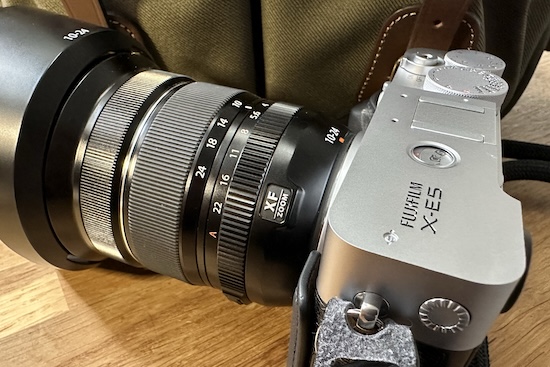
Personally, outside work, I use a Fujifilm X-E5 with an XF50-140mm F2.8 R LM OIS WR and an XF10-24mm F4 R OIS WR, both bought used.
Nikon now uses two main mounts: the F mount, used by older SLRs, and the Z mount, developed for Nikon mirrorless cameras. F-mount lenses can still be interesting, particularly used, but for a new mirrorless setup, the Z mount is now the preferred choice.
Nikon F lenses: the older SLR mount
Here are some representative F-mount lenses. Prices are deliberately indicative, as many of these lenses are now mainly available used.
| Budget | Under €350 | €350 to €800 | €800 to €1,500 | €1,500 to €2,000 | Over €2,000 |
| Wide angle | Nikon AF-S 18-35mm F3.5-4.5G ED (used) | Nikon AF-S 16-35mm F4G ED VR (used) | Nikon AF-S 14-24 mm F2.8G ED (used) | none | none |
| 50 mm | Nikon AF-S 50 mm F1.8G (around 200 euros) | Nikon AF-S 50 mm F1.4G (used) | none | none | none |
| Standard zoom | Nikon AF-S 24-85 mm F3.5-4.5G ED VR (used) | Nikon AF-S 24-120mm F4G ED VR (used) | Nikon AF-S 24-70 mm F2.8G ED (used) | Nikon AF-S 24-70 mm F2.8E ED VR (used) | Nikon AF-S 24-70mm F2.8E ED VR (new, around €2,350) |
| Telephoto zoom | Nikon AF-P 70-300 mm F4.5-5.6E ED VR (used) | Nikon AF-S 70-200 mm F4G ED VR (used) | Nikon AF-S 200-500mm F5.6E ED VR (used) | Nikon AF-S 70-200 mm F2.8E FL ED VR (used) | none |
| Prime telephoto | none | Nikon AF-S 300 mm F4E PF ED VR (used) | none | none | Nikon AF-S 500mm F5.6E PF ED VR (used, depending on condition) |
Nikon Z lenses: the current mirrorless mount
For a new Nikon mirrorless purchase, the Z mount is now the logical choice. Prices below are deliberately rounded and may vary depending on promotions and retailers. Nikon offers, among others, the NIKKOR Z 24-120mm F4 S at around €1,300, the Z 24-70mm F2.8 S at around €2,600 and the Z 70-200mm F2.8 VR S at around €2,550.
| Budget | Under €450 | €450 to €800 | €800 to €1,500 | €1,500 to €2,000 | Over €2,000 |
| Wide angle | Nikon Z 28mm F2.8 (around €300) | none | Nikon Z 17-28mm F2.8 (around €1,100) | Nikon Z 14-30mm F4 S (around €1,500) | Nikon Z 14-24 mm F2.8 S (around €2,800) |
| 50 mm | Nikon Z 40mm F2 (around €300) | Nikon Z 50 mm F1.4 (around €550) | none | none | Nikon Z 50 mm F1.2 S (around €2,100) |
| Standard zoom | Nikon Z 24-50 mm F4-6.3 (around €450) | Nikon Z 24-105 mm F4-7.1 (around €550) | Nikon Z 24-120mm F4 S (around €1,300) | none | Nikon Z 24-70 mm F2.8 S / Z 24-70 mm F2.8 S II (around €2,600 to €2,850) |
| Telephoto zoom | none | none | Nikon Z 24-200 mm F4-6.3 VR (around 1 000 euros) / Nikon Z 70-180mm F2.8 (around €1,400) | none | Nikon Z 100-400 mm F4.5-5.6 VR S (around €3,000) / Nikon Z 70-200 mm F2.8 VR S (around €2,600) / Z 180-600mm F5.6-6.3 VR (around €2,250) |
| Prime telephoto | none | none | Nikon Z 85 mm F1.8 S (around €800) | none | Nikon Z 400 mm F4.5 VR S (around €3,000) / Z 600mm F6.3 VR S (around €5,800) |
For an all-purpose setup, the NIKKOR Z 24-120mm F4 S is particularly interesting: its 24-120mm range covers a large part of typical photojournalism needs while remaining around €1,300. For professional photographers, the trio of NIKKOR Z 14-24mm F2.8 S, Z 24-70mm F2.8 S and Z 70-200mm F2.8 VR S is a very complete combination.
Sony now uses two main mounts for its cameras: the A mount, inherited from SLRs and now discontinued, and the E mount, used by Alpha mirrorless cameras. A-mount lenses can still be interesting used, but for a new mirrorless setup, the E mount is now the logical choice. Sony distinguishes full-frame “FE” lenses from APS-C “E” lenses.
Sony A-mount lenses: the older SLR mount
Here are some representative A-mount lenses. Prices are deliberately given as rough indications, as these lenses are now mainly sought on the used market. Sony still lists some A-mount lenses on its website, but without public pricing for most of them.
| Budget | Under €350 | €350 to €800 | €800 to €1,500 | €1,500 to €2,000 | Over €2,000 |
| Wide angle | Sony DT 11-18mm F4.5-5.6 (used) | Sony 16-35mm F2.8 ZA SSM II (used) | none | none | none |
| 50 mm | Sony 50 mm F1.8 (used) | Sony 50 mm F1.4 ZA SSM (used) | none | none | none |
| Standard zoom | Sony 28-75mm F2.8 SAM (used) | Sony 24-105 mm F3.5-4.5 (used) | Sony 24-70 mm F2.8 ZA SSM II (used) | none | none |
| Telephoto zoom | Sony 70-300 mm F4.5-5.6 G SSM II (used) | Sony 70-200 mm F2.8 G SSM II (used) | Sony 70-400 mm F4-5.6 G SSM II (used) | none | none |
| Prime telephoto | Sony 85 mm F2.8 SAM (used) | Sony 135 mm F2.8 STF (used) | Sony 300 mm F2.8 G SSM II (used) | none | Sony 500mm F4 G SSM (used, depending on condition) |
Sony E-mount lenses: the current mirrorless mount
For a new Sony Alpha mirrorless purchase, the E mount is now the logical choice. FE lenses are designed for full frame, while E lenses are intended for APS-C. Prices below are deliberately rounded to remain indicative over time. Sony offers, among others, the FE 20-70mm F4 G at around €1,600, the FE 24-70mm F2.8 GM II at around €2,400 and the FE 70-200mm F2.8 GM OSS II at around €3,000.
| Budget | Under €350 | €350 to €800 | €800 to €1,500 | €1,500 to €2,000 | Over €2,000 |
| Wide angle | Sony FE 28mm F2 (around €300) | Sony FE 24 mm F2.8 G (around €620) | Sony FE PZ 16-35mm F4 G (around €1,350) | none | Sony FE 16-35mm F2.8 GM II (around €2,700) |
| 50 mm | Sony FE 50 mm F1.8 (around €250) | Sony FE 50 mm F2.5 G (around €620) | none | Sony FE 50 mm F1.4 GM (around €1,700) | Sony FE 50 mm F1.2 GM (around €2,300) |
| Standard zoom | Sony FE 28-70 mm F3.5-5.6 OSS II (around €480) | none | Sony FE 24-50 mm F2.8 G (around €1,300) / Sony FE 20-70 mm F4 G (around €1,600) | none | Sony FE 24-70 mm F2.8 GM II (around €2,400) |
| Telephoto zoom | none | none | Sony FE 24-240mm F3.5-6.3 OSS (around €850) / Sony FE 70-180mm F2.8 (around €1,400) | Sony FE 70-200 mm F4 Macro G OSS II (around €2,000) / FE 200-600mm F5.6-6.3 G OSS (around €1,900) | Sony FE 100-400 mm F4.5-5.6 GM OSS (around €2,600) / FE 70-200 mm F2.8 GM OSS II (around €3,000) |
| Prime telephoto | none | Sony FE 85 mm F1.8 (around €700) | Sony FE 100mm F2.8 Macro GM OSS (around €1,600) | Sony FE 135 mm F1.8 GM (around €1,900) | Sony FE 300 mm F2.8 GM OSS (around €6,700) |
For an all-purpose setup, the FE 20-70mm F4 G is particularly interesting thanks to its 20-70mm range and relatively compact size. For a professional setup, the FE 16-35mm F2.8 GM II, FE 24-70mm F2.8 GM II and FE 70-200mm F2.8 GM OSS II make a very complete combination.
When you use your lens in difficult conditions (dust, mud, water droplets, sand, seaside environments), or if you want to permanently protect the front element from scratches and accidental impacts, you can use protective filters. “Neutral”? Not quite: a protective filter transmits around 99% of the light received and may have a tiny effect on colour temperature. This is of course invisible to the naked eye, and the important thing is to protect your lenses. Several types of protective filters are available, chosen according to your lens diameter (from 37 to 82mm) and glass quality (avoid putting a cheap filter on a €2,000 lens, and vice versa). Some photographers use UV filters for protection: they also provide protection, but modern lenses already have UV coatings. Best avoided for that reason.
More important than a protective filter, and essential: the lens hood, either optional or supplied with the lens (Canon L series, Sigma, etc.). A lens hood provides excellent mechanical protection for the front element and prevents stray side light that can cause flare (bright circles in the image) and reduce contrast.
Each lens has a specific hood model (diameter, shape and length). It attaches to the lens and is perfectly matched to its characteristics.
Contrary to popular belief, and despite its name, a lens hood is very useful in bad weather (it partly protects against rain), as well as in cloudy conditions or indoors (to limit stray incident light).
For those who are curious, here is how my professional setup evolved. From 2013 to 2023, I mainly used a Canon 100-400 L telephoto (version II, excellent), a Canon 14mm f/2.8L II ultra-wide (also excellent), a Canon 24-105L (version I, which I found rather disappointing, especially at 24mm because of its distortion) and a 70-200mm f/2.8L II. For camera bodies, I used Canon 1D X Mark I and Mark II bodies. If I had to keep only two lenses at the time, without hesitation they would have been the 14mm and the 100-400.
My main professional setup is now a Canon R3 with an RF 100-500mm and an RF 14-35mm. I also use an RF 70-200mm f/2.8L IS USM, particularly for portraits and basketball and handball coverage. On the Côte d’Opale, three photographers also share a Canon R6 Mark II and an RF 100-300mm f/2.8L IS USM, giving us additional equipment when assignments require it.
Most of my colleagues chose a trio consisting of an RF 24-70mm f/2.8L IS USM, an RF 15-35mm f/2.8L IS USM and an RF 70-200mm f/2.8L IS USM. With a similar budget, I made a different choice: I decided to skip the 24-70mm in favour of the RF 100-500mm, keep the 70-200mm f/2.8 and choose a more affordable wide angle, the RF 14-35mm. This better suits my needs as a photojournalist, especially the usefulness of the 100-500mm for subjects that require working from a distance.
The entire La Voix du Nord photo department (15 photographers) has now switched to Canon mirrorless cameras.
How to choose a lens?
The lens is the component that has the greatest impact on image sharpness [...]
How to choose a camera?
Today, the choice is mainly between mirrorless cameras and the used market [...]
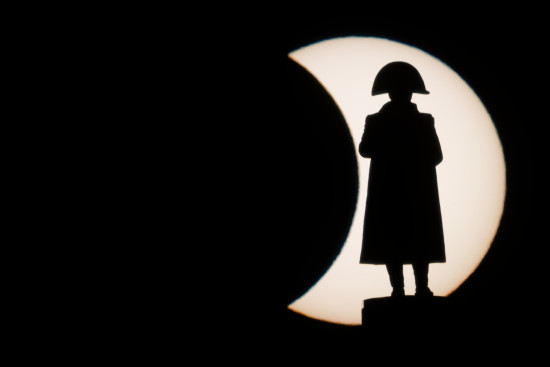
How I photographed Napoleon during the solar eclipse?
An image like this does not happen by chance [...]

How I set up my camera
There is obviously no universal setting that works for every situation. The choices [...]

How to choose a camera bag
Finding the perfect camera bag to carry and protect your valuable equipment is [...]

How to choose a computer?
Clearly, in 2026, any recent laptop or desktop computer, whether PC or Mac, can [...]
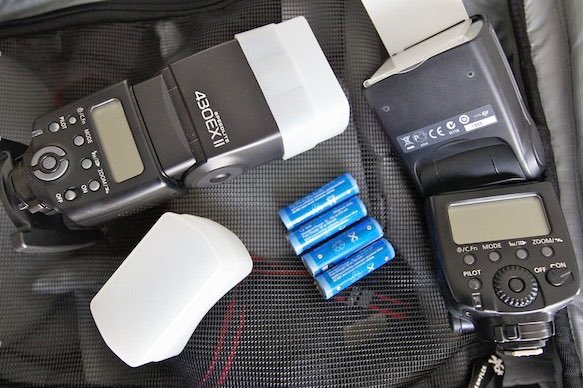
How to choose a speedlight?
A speedlight is far from essential for taking good photographs. Recent cameras [...]

Photographing amateur football
For those getting started in sports photography, covering an amateur football match is a good choice [...]
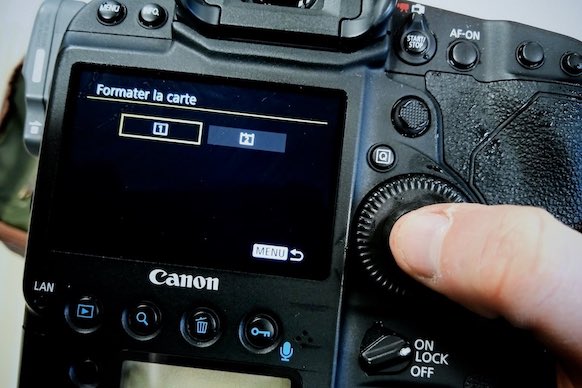
Recovering deleted photos
Accidentally deleting the contents of a memory card by formatting it can happen to anyone: don't panic [...]
My workflow with DxO and Photo Mechanic
Why I spend less than a minute (per photo) on post-processing my assignments [...]

Photographing sports
Sports photography is quite a challenging field to master. It requires [...]

Getting press accreditation
Press accreditation is the essential pass that allows you to photograph a concert, event [...]

Photographing a concert
Photographing a concert or show is relatively complex, but very rewarding [...]
Photographing a sunset
Photographing a sunset is a real treat for both the eyes and the photographer, impossible to [...]

10 tips for better photos
A few tips, in no particular order, to avoid common mistakes. The very first tip [...]

How to create a panning effect?
Essential for photographing motorsports such as rallies, F1 or [...]

Photography in the rain
As I live in Pas-de-Calais, I should have some expertise when it comes to answering this [...]
Photography basics
When taking a photograph, the photographer can adjust four parameters to compose and control [...]