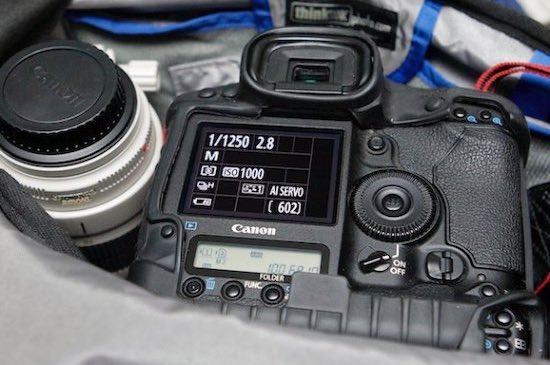
Photography Basics
When taking a photograph, the photographer can adjust four parameters to compose and control image exposure: focal length and aperture on the lens, and shutter speed and sensor sensitivity on the camera body. Depending on the settings, you can freeze fast action, isolate a subject (blurred background), or photograph a landscape with a large area of sharpness in daylight or at night (long exposure). Here is an overview of the technical basics to know before buying a camera.
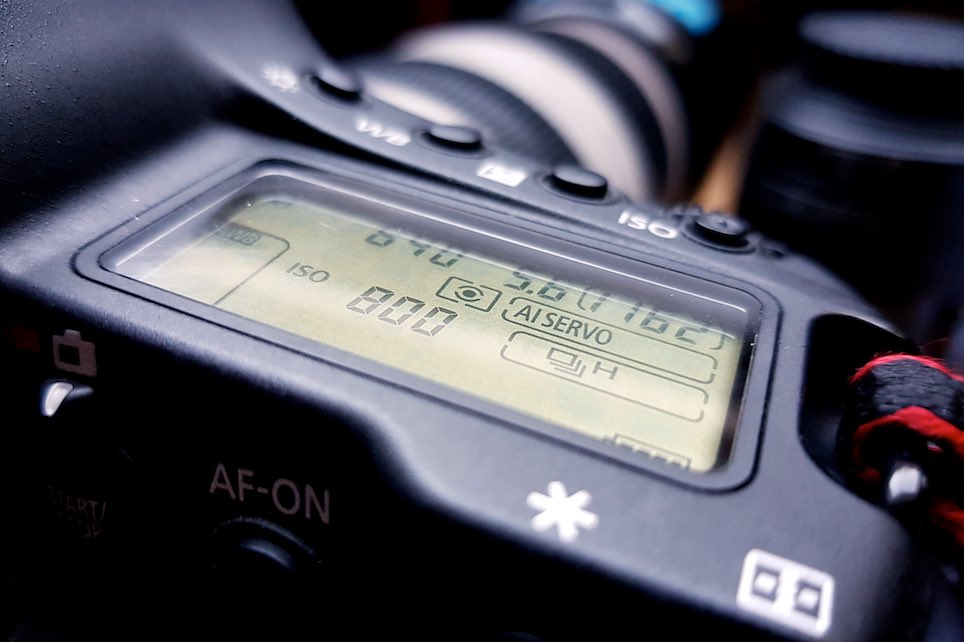
The camera's top LCD displays the settings (on enthusiast and professional bodies): here ISO 800 for sensitivity, 1/640 for shutter speed and f/5.6 for aperture. There are 1,162 shots remaining. AWB is automatic white balance, and AI Servo is autofocus tracking when the subject moves.
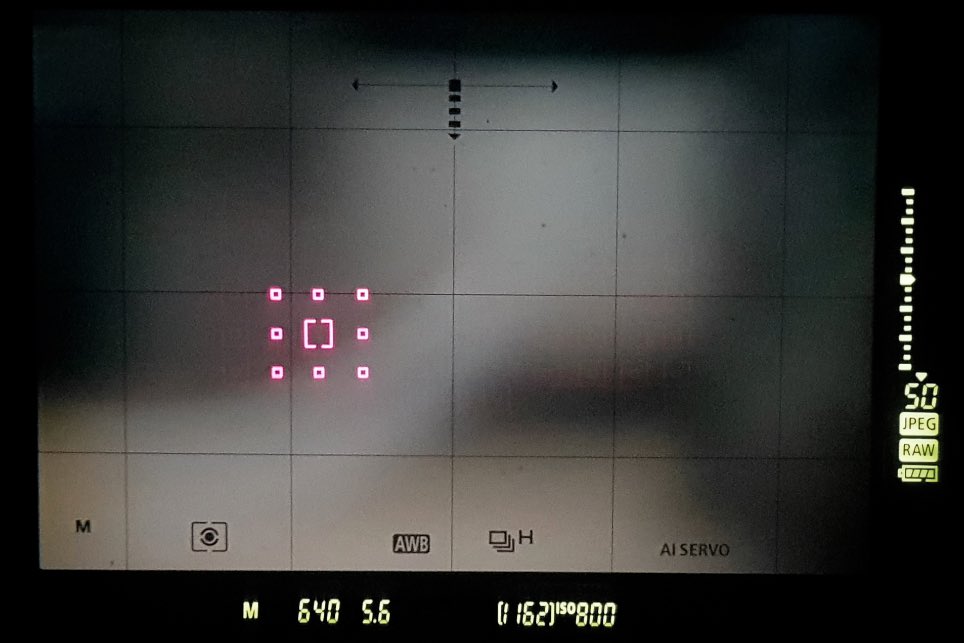
The viewfinder shows Manual mode (M), a shutter speed of 1/640, an aperture of f/5.6 and ISO 800. In red is the AF point: focus will be made there. You can choose the area you want by selecting other AF points.
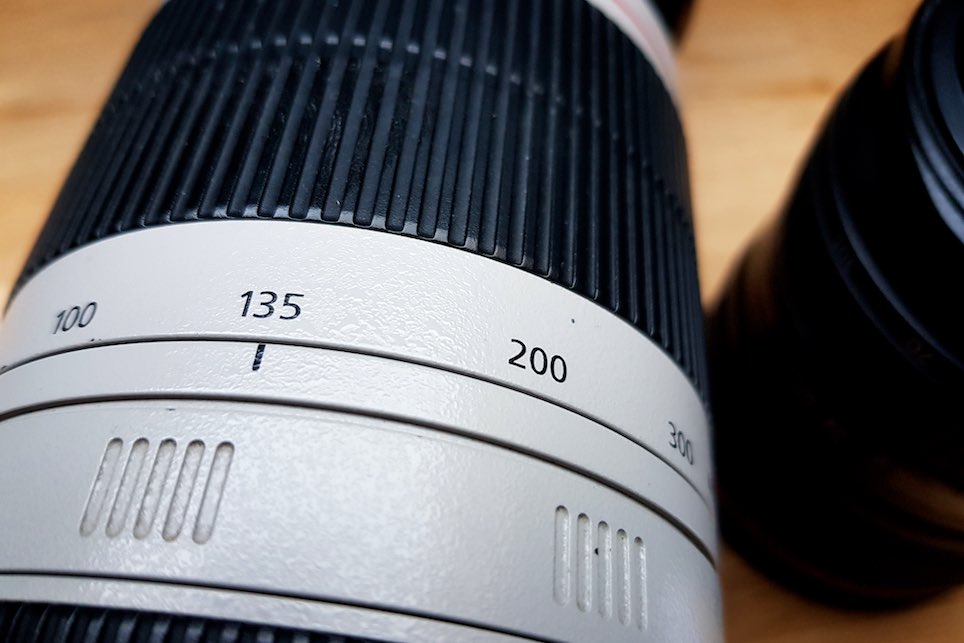
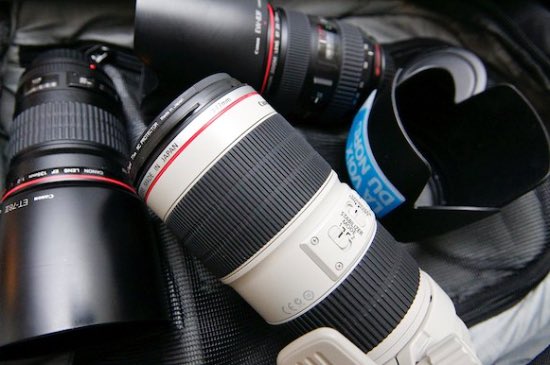
A Canon 100-400mm f/4.5-5.6 telephoto lens. This means it can open to f/4.5 at 100mm and f/5.6 at its maximum focal length, 400mm (so you lose light when zooming in). Here it is set to 135mm.
Shutter speed
A DSLR camera has a shutter: a curtain mechanism that covers the sensor when it is at rest. This curtain opens at a faster or slower speed to expose the sensor to light for a shorter or longer time.
The faster the shutter speed, the less light reaches the sensor.
On a DSLR, shutter speed can be set from 1/8000 to 30 seconds in 1/2- or 1/3-stop increments.
Standard shutter speeds are: 1/8000, 1/6400, 1/5000, 1/4000, 1/3200, 1/2500, 1/2000, 1/1600, 1/1250, 1/1000, 1/800, 1/640, 1/500, 1/400, 1/320, 1/250, 1/200, 1/160, 1/125, 1/100, 1/80, 1/60, 1/50, 1/40, 1/30, 1/25.
For long exposures (a tripod is required, otherwise slight photographer movement will blur the image): 1/20, 1/15, 1/13, 1/10, 1/8, 1/6, 1/5, 1/4, 0"3 (0.3 sec), 0"4, 0"5, 0"6, 0"8, 1", 1"3, 1"6, 2", 2"5, 3"2, 4", 5", 6", 8", 10", 13", 15", 20", 25", and 30".
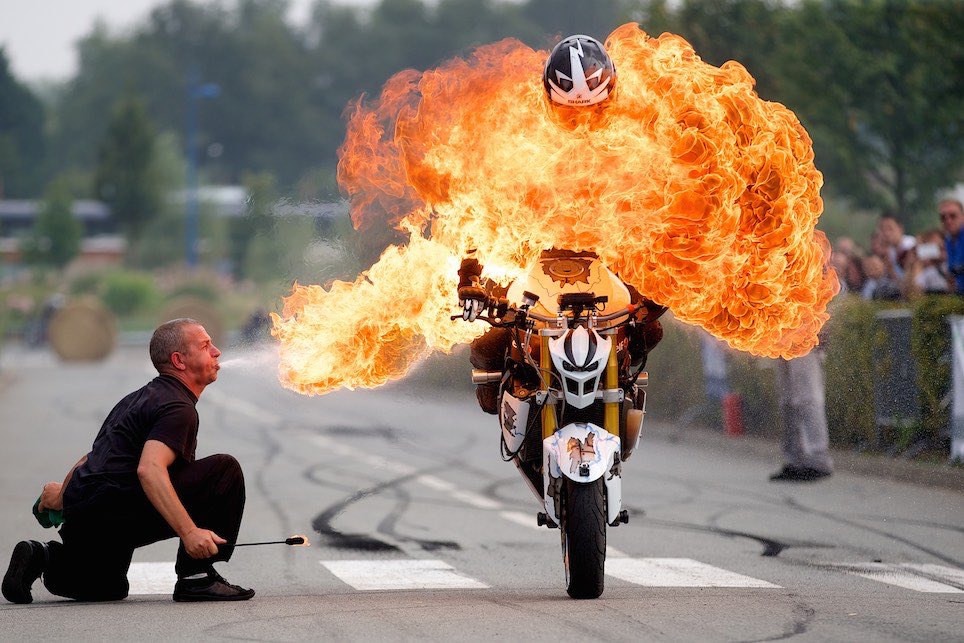
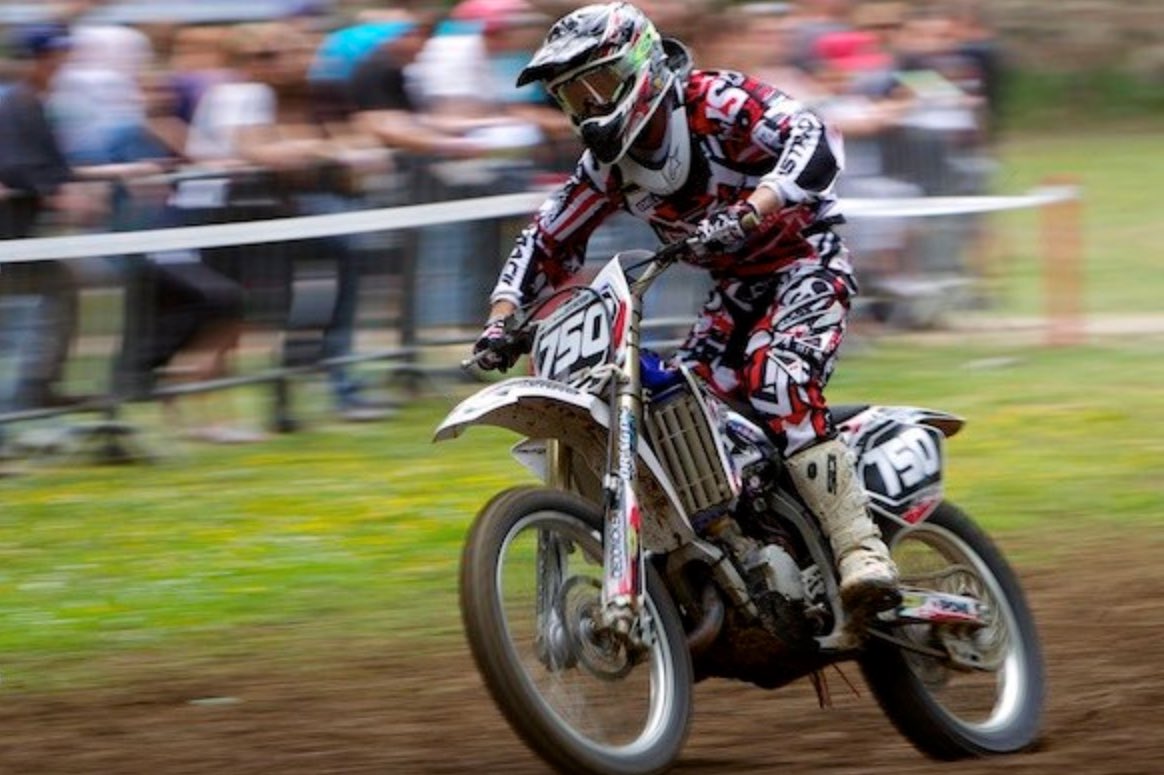
Key point: Shutter speed allows you to freeze a moving subject: the larger the number after 1/, the more motion is frozen (from 1/400 onward). The lower this number, the greater the risk of motion blur. Motion blur can also be intentional to make an image more dynamic.
Without a tripod or image stabilization, shutter speed should always be at least the reciprocal of the focal length used to avoid camera shake caused by the photographer's movements. This rule can be relaxed with a stabilized lens, although it is not magic.
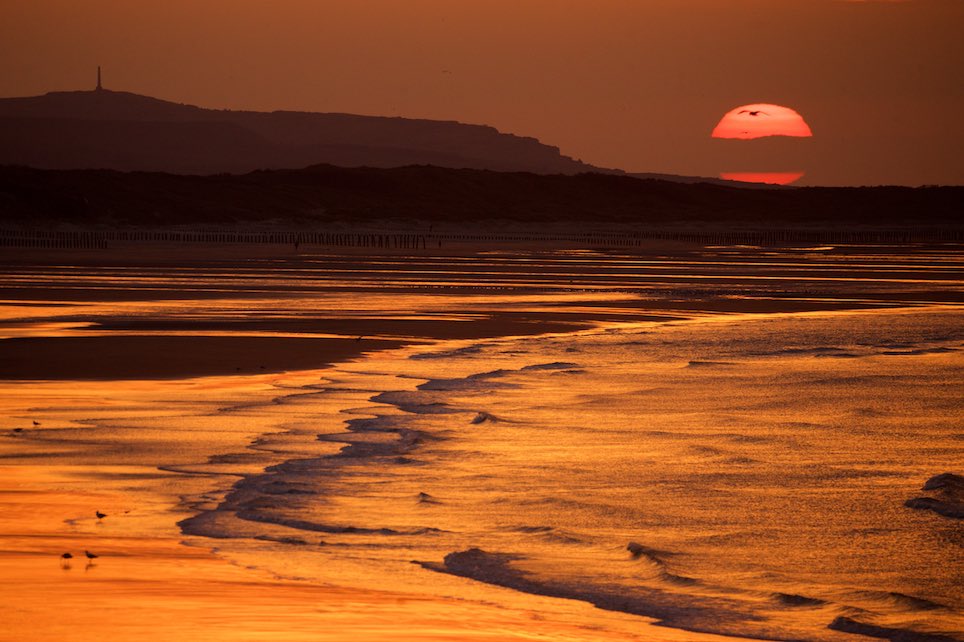
Example: with a 200mm lens, the minimum handheld shutter speed should be 1/200. A slow speed (1/10, 1/30) or a long exposure (several seconds) can create dynamic effects: a "ghost" silhouette when a passer-by enters the frame, multiple fireworks explosions, a smooth effect on moving sea or a waterfall, car headlight trails at night... the only limit is your imagination.
Using a slow shutter speed with a tripod, especially at night, also allows you to obtain greater depth of field by stopping down the aperture (letting in less light) without increasing ISO sensitivity (and therefore image noise).

A fast shutter speed (1/1600) freezes the mud.
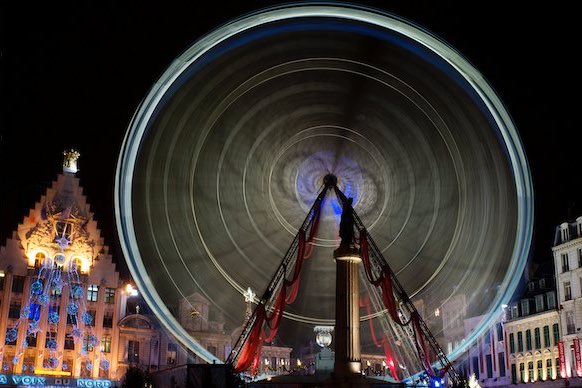
A long exposure (9 seconds) creates a dynamic image.
Aperture
A lens has a diaphragm: essentially a mechanical aperture whose diameter varies to let in more or less light. When we talk about aperture, we are referring to the opening of the diaphragm. The maximum aperture of a lens is determined by the front element diameter and focal length according to the formula Aperture = focal length / front element diameter. Thus, a Canon 200mm lens with a 72mm diameter has an aperture of 200/72 = 2.77, and the Canon 200mm L actually has a maximum aperture of f/2.8. This explains why most zoom lenses have a variable maximum aperture: a Canon 70-300 f/4.5-5.6 has an aperture of f/4.5 at 70mm and f/5.6 at 300mm.
High-end zoom lenses offer a constant maximum aperture regardless of the focal length used (by stopping down the diaphragm at the wide-angle end). Take a Canon 70-200 f/2.8: the front element diameter is 77mm, which would give a theoretical maximum aperture of 200/77 = 2.59 at 200mm and 70/77 = 0.90 at 70mm. To obtain a constant f/2.8 aperture, the manufacturer uses only 25mm (70/2.8) of the front element diameter at 70mm, 48mm (135/2.8) at 135mm, and so on. It is a complex and costly technology, but it gives the photographer great flexibility.
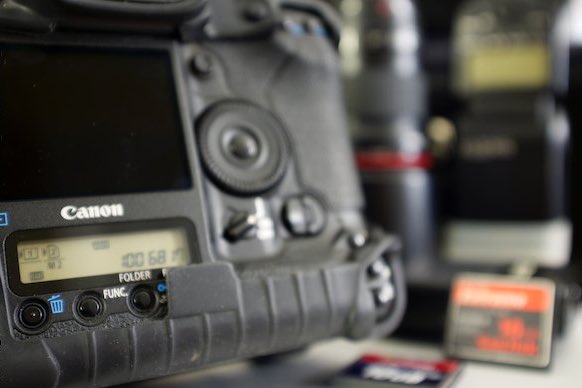
A wide aperture (f/2.8) produces shallow depth of field
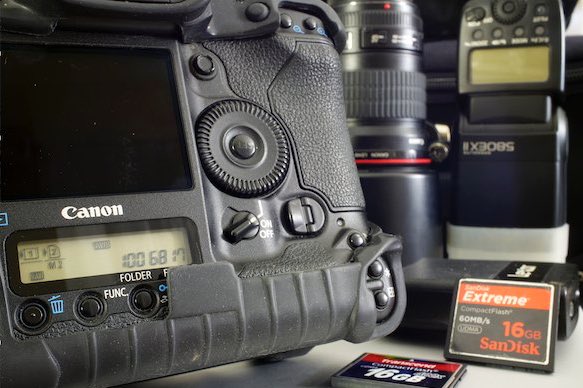
A narrow aperture (f/16) produces deep depth of field
Standard aperture values are: f/1.2, f/1.4, f/1.8, f/2, f/2.8, f/3.5, f/4, f/4.5, f/5.6, f/6.3, f/8, f/9, f/11, f/13, f/16, f/18, f/20, f/22, f/25, f/29, and f/32.
Key point: The larger the number after f/, the greater the area of sharpness. Aperture has a direct effect on depth of field (see below). Choose your aperture according to the area of sharpness you want and the brightness of the scene.
If a large area of sharpness is essential but there is little light (at night), the only solution is to mount your equipment on a tripod and use a long exposure (the shutter remains open for several seconds).
ISO sensitivity
It is the camera's sensitivity to light. Good high-ISO performance (ISO 3200 or 6400) makes it possible to photograph indoors without a flash. In sports or wildlife photography, it is a crucial criterion.
Between each ISO sensitivity setting, the multiplier is generally two. Common values are: 100, 200, 400, 800, 1600, 3200, 6400, 12800.
However, most camera bodies also offer intermediate values: 320, 640, 1250, 2000, 2500, 4000, 5000, 8000.
To understand how ISO sensitivity works, you need to know that your camera sensor has a base sensitivity of 100 (Canon) or ISO 200 (Nikon). When you increase ISO in the camera settings to compensate for a lack of light, the base signal of ISO 100 or 200 is amplified by an electronic circuit (10 times to obtain ISO 1000, for example). This is why electronic noise or grain appears when using high sensitivities (above ISO 3200).
Key point: Choosing ISO sensitivity is a compromise, but the lower it is, the better the image quality. Do I need a fast shutter speed? A narrow aperture to obtain a large area of sharpness? Depending on the subject, each parameter must be adapted: ideally, use the lowest possible ISO sensitivity to obtain the best image quality.
Focal length
Expressed in millimetres, focal length is the distance between the camera sensor (24x36mm format) and the optical centre of the lens. Focal length affects subject magnification and angle of view. The shorter the focal length, the wider the angle of view. A 16mm wide-angle lens therefore provides a very wide field of view, while a 400mm telephoto lens provides a very narrow angle of view. There are two categories of lenses: prime lenses and variable-focal-length lenses (zooms). For example, a Canon 24-105 f/4L has a focal range from 24mm to 105mm, a 4.3x zoom (105mm/24mm). A zoom is often more practical, especially when you cannot move around the subject, although a prime lens is generally much sharper.
A lens's focal length is specified for a 24×36 sensor (film SLR or high-end digital SLRs such as the Canon 1D and 5D, or the Nikon D3 and D700). On most digital SLRs, the sensor is smaller than 24×36, so the final image is magnified by a crop factor. The crop factor is 1.6x for Canon and 1.5x for Nikon.
Thus, on a Canon APS-C body (for example the 60D or 7D), a 200mm lens becomes 200×1.6, or 320mm. This is an undeniable advantage for users of long focal lengths (sports, wildlife), but a major disadvantage for wide-angle users: a 14mm becomes 22mm.
Key point: Focal length affects subject magnification and angle of view. The shorter the focal length, the wider the angle of view. Like aperture, focal length affects depth of field (see below): to isolate a subject (portrait), use a long focal length (85, 135, 200mm).
Depth of field
It is the area of sharpness in the image. It depends on focal length, aperture, the subject's position relative to the background, the photographer's distance from the subject, and sensor size. The larger the sensor, the shallower the depth of field. It is also reduced when using a long focal length (135, 200, 300, 400mm) and a wide aperture (f/2, f/2.8). To isolate the subject well, the subject must be sufficiently far from the background and the photographer should not be too far from the subject. A person will be perfectly isolated if photographed 3m from a tree, but if the tree is 50cm away, depth of field will be too great and the subject will not stand out from the background. The same applies to the photographer's distance from the subject: the closer the photographer is to the subject, the shallower the depth of field.
Key point: To create a portrait with a blurred background, simply use a long focal length (135mm, for example), a wide aperture (f/2.8), and keep the subject well separated from the background. For a landscape, on the other hand, the area of sharpness should be large: use a short focal length (wide angle, 24mm) and a narrow aperture (f/11).
Practical examples of settings
To obtain a correctly exposed image, you therefore have to balance shutter speed, aperture and ISO sensitivity: three parameters that are completely linked. If a good exposure is achieved with the following settings: 1/250 – f/4 – ISO 200, changing the shutter speed from 1/250 to 1/500 (twice as fast) will produce an underexposed (dark) image.
You therefore need to compensate by opening the aperture to f/2.8 to let in twice as much light, or increase sensor sensitivity to ISO 400 (1/250 – f/4 – ISO 200 or 1/500 – f/2.8 – ISO 200 or 1/500 – f/4 – ISO 400).
| Subject |
Shutter speed
|
Aperture
|
ISO
|
Focal length
|
Daytime sports
|
1/500 minimum, 1/1000 if possible. |
f/4 to isolate the athlete well. f/5.6 with a less bright lens. |
ISO 100 or 200 in sunny weather, ISO 400 if your lens is not very bright (f/5.6) or if the weather is cloudy |
Long focal length (200 to 400mm) |
Night sports
|
1/500 minimum, 1/1000 if possible. |
f/2.8 |
ISO 1600 to 6400 depending on the venue or stadium |
Long focal length (200 to 400mm) |
Daytime portrait
|
1/100 with a 50 or 85mm, 1/200 with a 135 or 200mm |
f/4 or wider. |
ISO 100 or 200 |
50, 85, 135, 200mm |
Night portrait
|
1/100 with a 50 or 85mm, 1/200 with a 135 or 200mm |
f/2.8 or wider |
ISO 1600 to 6400 depending on room brightness |
50, 85, 135, 200mm |
Daytime landscape (without tripod)
|
1/50 |
f/11 or narrower |
ISO 100 to 400 depending on sunlight |
16 to 24mm |
Night landscape (tripod)
|
2 to 30 seconds |
f/8 or narrower |
ISO 100 or 200 |
16 to 24mm |
Child moving in a park or garden
|
1/500 minimum. Adjust according to sunlight to obtain an aperture of f/4 or f/5.6. |
f/4 to isolate the child well. f/5.6 with a less bright lens. |
ISO 100 or 200 in sunny weather, ISO 400 if your lens is not very bright (f/5.6) or if the weather is cloudy |
Long focal length (70 to 400mm) |
With a little practice, you will no longer question which settings to use: choosing one setting or another will become obvious. Be patient… And rest assured, the technical side is far from the most important thing; what matters is your sensitivity, your eye and your vision.
You can also read How I Set Up My Camera, where I explain how I set up my camera day to day in my work as a photojournalist.