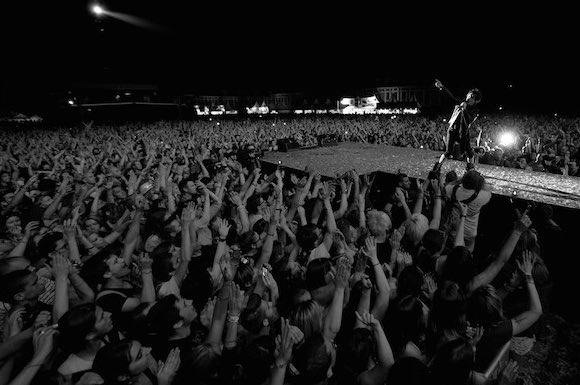
Indochine performing at the Main Square Festival in Arras. A monopod and a remote release allow me to get this image.
14 mm - 1/640 - 5000 ISO - f/2.8

How to photograph a concert or show?
As with sports photography, photographing a concert or show is relatively complex, but very rewarding because of the proximity to the artists and the stage. The light is often highly irregular, so you constantly have to adjust your settings to obtain a properly exposed photograph.
Good command of your equipment, including in the dark, allows you to remain highly responsive — essential if you are lucky enough to cover an important concert.
In most cases, major productions allow photographers to work only during the first three songs, or for around ten minutes. If you are starting out, it is a good idea to practice in a small venue or bar where admission is free: there will be no problem photographing the concert
entirely or to get press accreditation.
Indochine performing at the Main Square Festival in Arras. A monopod and a remote release allow me to get this image.
14 mm - 1/640 - 5000 ISO - f/2.8
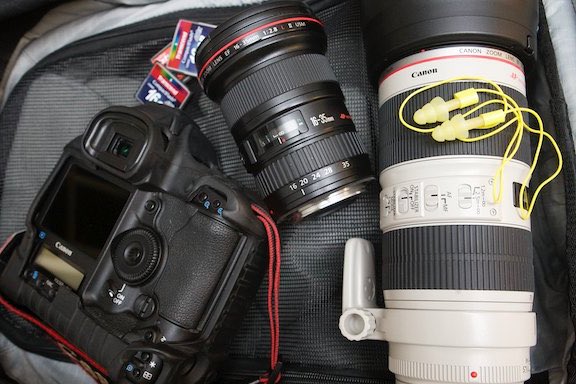
The ideal equipment for covering a concert: a professional or semi-professional camera with good high-ISO performance (clean at ISO 6400), a wide-angle lens such as a 16-35mm f/2.8, a 70-200mm f/2.8, and essential earplugs.
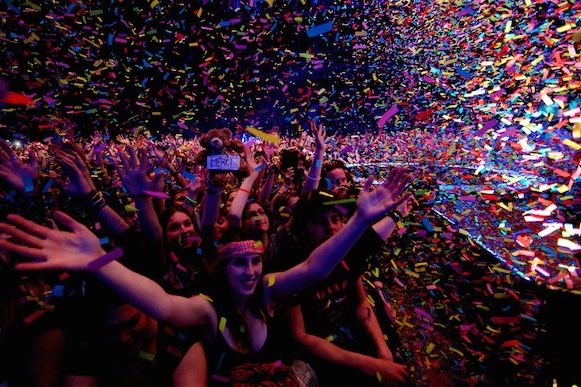
Another Indochine concert, at Gayant Expo. Often, the press can photograph only the first three songs, but the artists play along. 14 mm - 1/640 - 4000 ISO - f/2.8
One camera body is enough; there is no need to carry two. Good high-ISO performance is essential: it is not unusual to reach ISO 3200 or even 4000. Burst rate is of little importance: it is the photographer who has to press the shutter at the right moment.
Using several lenses allows you to vary your shots:
– A wide-angle lens for wide compositions: Canon 16-35 f/2.8, Nikon 14-24 f/2.8, Tokina 11-16 f/2.8, or a Tamron 17-50 f/2.8
– A 70-200mm telephoto lens for tighter compositions: Canon 70-200 f/2.8, Tamron 70-200 2.8, Sigma 70-200 2.8, Nikon 70-200 2.8. An 85mm or 135mm prime is also relevant: Canon’s 135mm f/2 offers excellent sharpness, at roughly twice the price of a 70-200 f/2.8 IS.
– A long telephoto lens, if needed: a 300mm f/2.8.
It is heavy, expensive and bulky, but such a lens can produce exceptional photographs and beautiful portraits.
A speedlight is not necessary: using one would completely alter the beautiful lighting atmosphere of the stage. It is also usually forbidden by the organizers.
Carrying everything in a shoulder bag (and possibly the 300mm f/2.8 over the other shoulder) is the most practical solution: access to the equipment is fast and lenses can be changed without putting the bag on the ground. A backpack can also work: the equipment feels lighter to carry, but you will be less responsive when shooting.
One last thing: it is advisable, and even essential, to bring earplugs when covering a concert. Compressed or expanded foam works for occasional use (a few euros at a pharmacy), while silicone is suitable for frequent use. Hearing protection greatly reduces sound levels (100 to 110 dB at a concert) and helps prevent hearing damage.
If you have an press pass, the most interesting place is of course the photo pit: a narrow area separating the stage from the audience. From there, you can photograph the stage or an artist with a wide-angle lens, or concentrate on one or two artists with a 70-200mm. With a 200-300mm focal length, you can also try very tight portraits of a singer to capture their expression or attitude. If the pit is crowded and difficult to move around in, avoid positioning yourself directly in front of the singer’s microphone stand from the outset: otherwise it can be difficult to photograph the artist without the microphone in front of their mouth.
Be creative: once you have what you need, look for other angles. Is there an opportunity to photograph the audience and stage from a higher viewpoint? Have you tried close-ups of strong details: a pianist’s hands on the piano, a guitarist’s pick, a violinist’s bow… Play with light and shadows: they are an integral part of the show, so make the most of them.
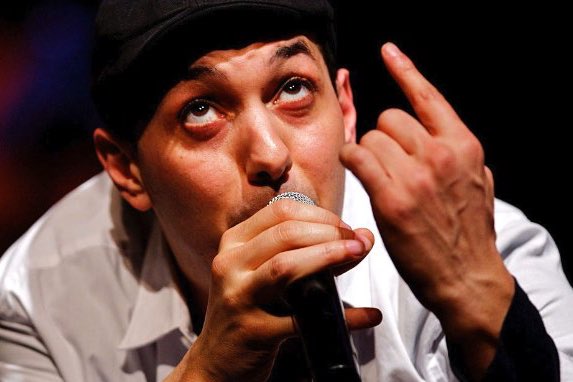
A long focal length lets you capture an interesting attitude from farther away and avoid the low-angle effect that is unavoidable from the photo pit…
300 mm - 1/800 - 3200 ISO - f/2.8
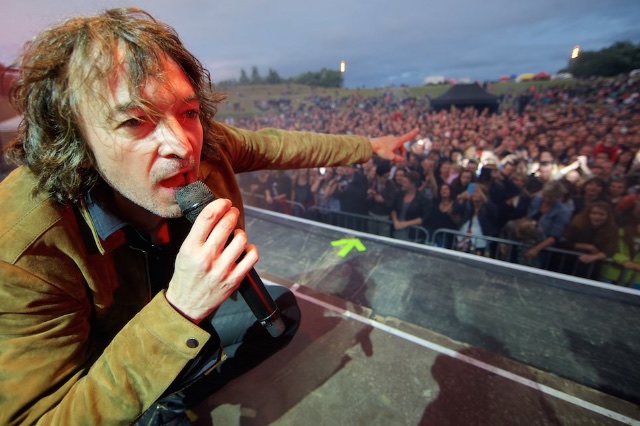
CALI in concert at Parc de la Fossette in Barlin. The artist kindly allowed me to go on stage, making this beautiful wide-angle image possible with the audience in the background.
14mm - 1/1600 - ISO 1600 - f/2.8
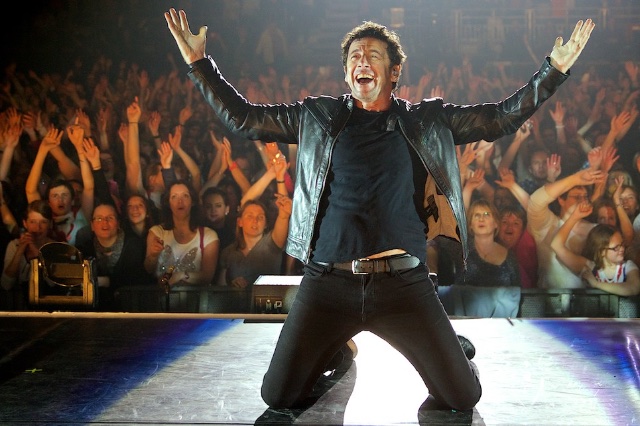
Patrick Bruel in concert at Gayant-Expo. One of my best memories: he allowed me to go on stage for a few minutes to make this photograph, with his audience in the background.
42 mm - 1/1000 - 2000 ISO - f/2.8
The audience is right behind you, so include them in your coverage: they are an integral part of the concert! To gain depth, you can raise your arm as high as possible for a few seconds and use Live View on your camera to avoid random framing thanks to the LCD screen, then disable Live View, half-press the shutter button for autofocus, and shoot! With this method and a little luck, you can get some great audience shots. If the audience is moving, 1/500 s is a minimum shutter speed. Also try to capture the connection between the artists and the audience: give those who look at your images goosebumps!
Important: never forget that the audience has paid for their ticket: respect them, be humble, and try to disturb them as little as possible during your assignment.
Photographing a show (stand-up comedy, theater) is more complex than a concert: there is no photo pit, so you have to stay to the side and be very discreet. It is also essential to minimize noise so as not to disturb the artists and audience: at a concert your shutter is inaudible, but for a show you should forget burst shooting and shoot frame by frame (single-shot mode). Some press photographers use sound-dampening covers to reduce shutter noise or use a mirrorless camera such as Sony’s NEX series or Fuji’s X-100. At a major production, you can generally cover only the first ten minutes of the show, so just as with a concert, you need to know your equipment inside out. To avoid disturbing seated spectators (who have paid for their tickets), it can be useful to move a little farther from the stage and use a 70-200mm for wider shots and a 300mm for tight shots.
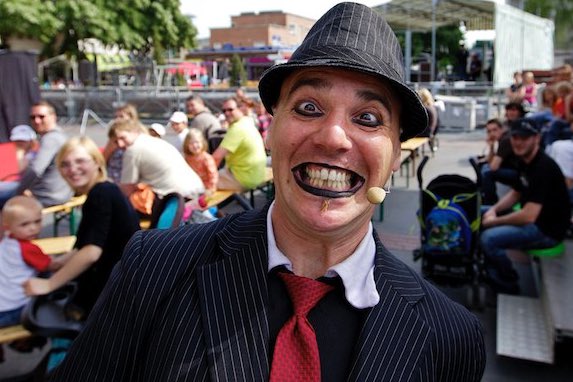
Photographing a street performance is accessible to everyone: do not hesitate to interact with the performer. It is the best way to get a very lively photograph!
16 mm - 1/1600 - 500 ISO - f/4
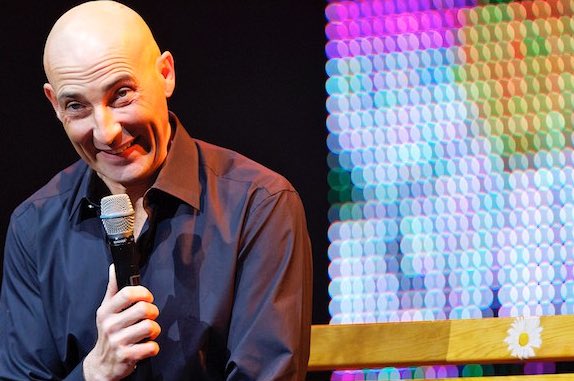
The keys to successful photographs: spot metering, manual mode, wide aperture, minimum shutter speed of 1/500 s, continuous autofocus (AI Servo on Canon, AF-C on Nikon). 300 mm - 1/800 - 1600 ISO - f/2.8
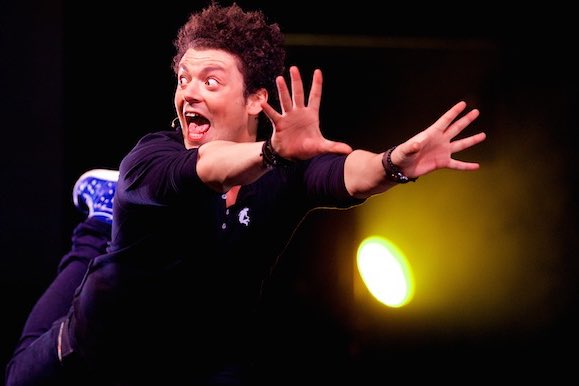
Photographing a show (stand-up comedy, theater) is more complex than a concert: there is no photo pit, so you have to stay to the side and be very discreet so as not to disturb the audience. 300 mm - 1/800 - 3200 ISO - f/2.8
Do not worry: for small shows, particularly schoolchildren’s end-of-year performances or street performances, photography is much less restrictive. There is often plenty of light and you can remain close to the stage throughout the performance.
During a concert, lighting and contrast can be extreme: part of the stage is lit, for example the singer, while the rest is very dark. By default, a DSLR meters light across several areas (evaluative on Canon and matrix on Nikon), but because most of the stage is dark, the camera will overexpose the image and the singer will be blown out (completely white)! To avoid this, meter the light only on the artist: that is the purpose of spot metering. In spot mode, the camera measures light only in a small area at the center of the image. With this essential mode for concert and show photography, the artist is correctly exposed while the background remains perfectly dark.
The light is often multicolored, making it impossible to manually change the white balance for every variation. So use automatic white balance: the result is rarely perfect, but usually quite acceptable. Prefer RAW rather than JPEG so you retain the ability to change white balance. RAW also allows you to correct exposure errors (an image that is too dark or too bright) and offers better dynamic range (highlights that are not blown out and shadows that are not blocked up).
For exposure mode, there are three possibilities:
– The aperture-priority mode (Av on Canon, A on Nikon): choose the widest aperture of the lens (for example f/2.8) and the ISO sensitivity (for example 2500), and the camera calculates the shutter speed needed for correct exposure. Simply adjust the ISO sensitivity to obtain a sufficiently fast shutter speed (for example 1/500 if the singer is very mobile, 1/200 if they are stationary).
– The manual mode (M on Canon and Nikon): choose the shutter speed, aperture and ISO sensitivity. The camera indicates in the viewfinder whether the image is correctly exposed; simply adjust one of the three parameters to obtain the correct exposure. As a reminder, you can read the photography basics tutorial. This mode is the most complex, but the most effective once mastered. During a concert, the drawback is that you have to constantly adjust the parameters because the light varies greatly: but it is like driving a car, over time you stop thinking about changing gears.
– The manual mode with Auto ISO: as above, you choose the shutter speed and aperture, and the camera chooses the ISO sensitivity for correct exposure. This mode is not available on every camera.
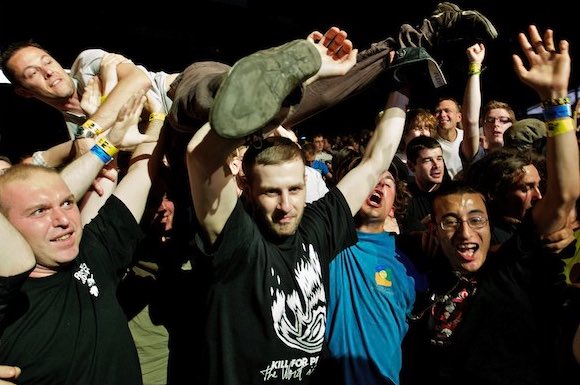
16 mm - 1/500 - 4000 ISO - f/2.8
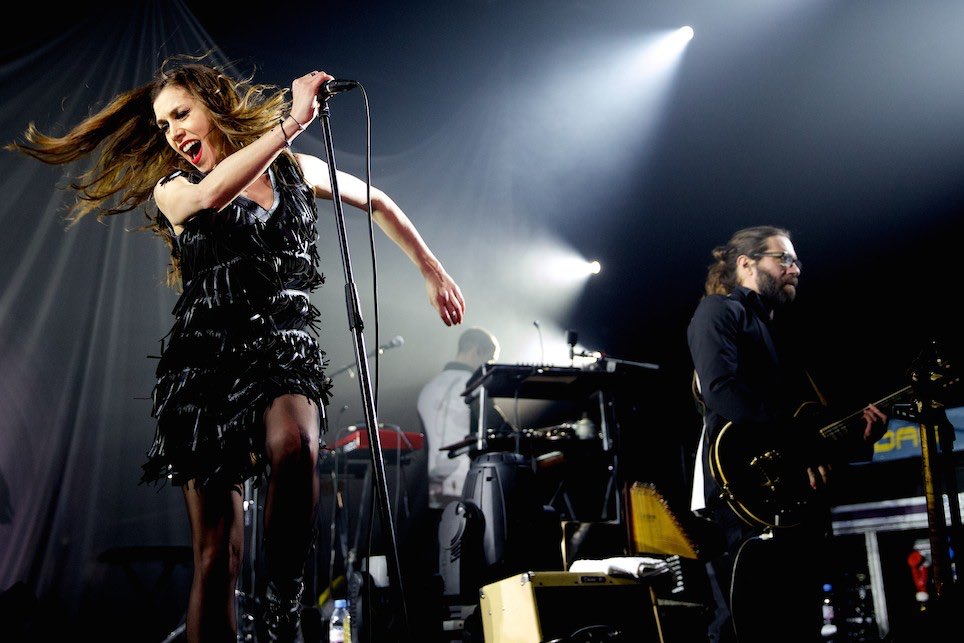
35 mm - 1/640 - 4000 ISO - f/2.8
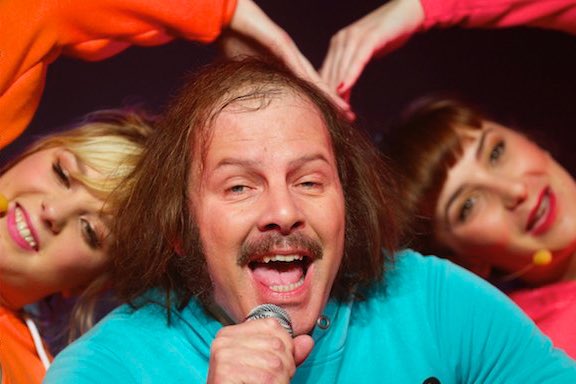
300 mm - 1/800 - 1000 ISO - f/2.8
Press accreditation is the precious pass that a photographer wears around their neck (it can also be a press/VIP wristband or a production sticker), and which is issued by the organizers at a concert or show. This mainly concerns major or medium-sized events: for a free concert in a small venue, press accreditation is rarely necessary.
The difficulty of obtaining accreditation varies greatly, because the importance of the event and its media coverage come into play. In general, you need legitimate credentials: to be a photojournalist, press correspondent, city photographer, or photographer for an agency or webzine. The organizer grants permission to use an artist’s image in exchange for press coverage or a report, so if you are coming purely as a private individual for fun, move on… If you want to practice concert photography, look for small municipal concerts or small festivals.
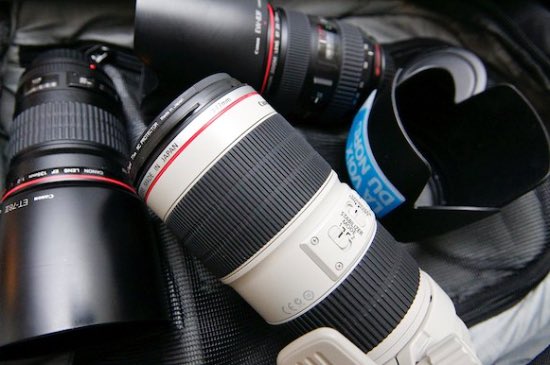
How to choose a lens?
The lens is the component that has the greatest impact on image sharpness [...]
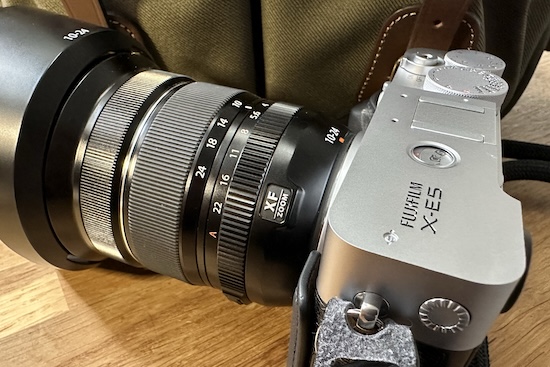
How to choose a camera?
Today, the choice is mainly between mirrorless cameras and the used market [...]
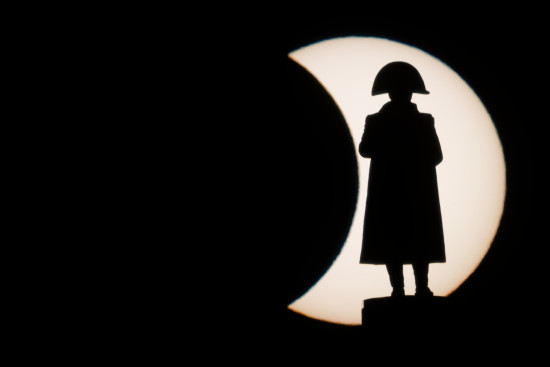
How I photographed Napoleon during the solar eclipse?
An image like this does not happen by chance [...]
How I set up my camera
There is obviously no universal setting that works for every situation. The choices [...]
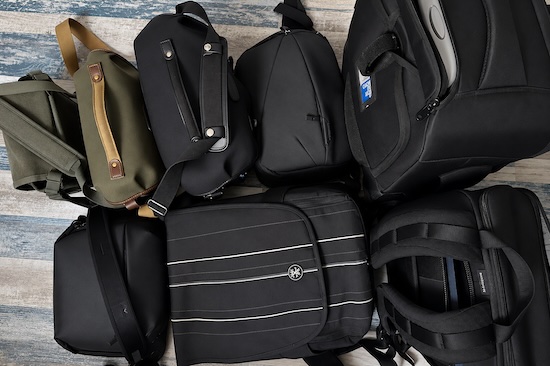
How to choose a camera bag
Finding the perfect camera bag to carry and protect your valuable equipment is [...]

How to choose a computer?
Clearly, in 2026, any recent laptop or desktop computer, whether PC or Mac, can [...]
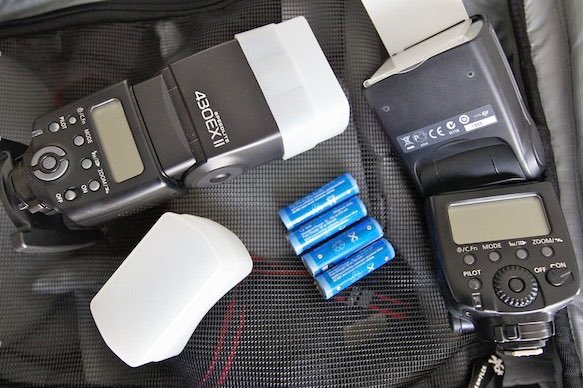
How to choose a speedlight?
A speedlight is far from essential for taking good photographs. Recent cameras [...]
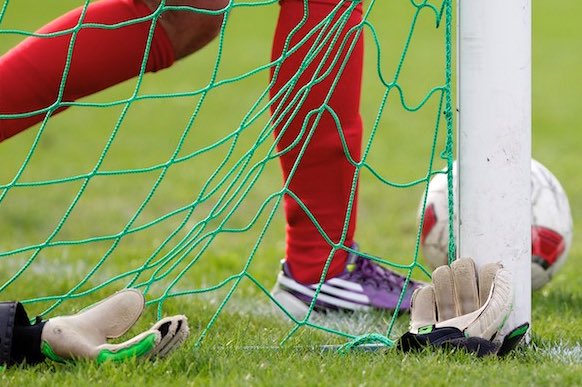
Photographing amateur football
For those getting started in sports photography, covering an amateur football match is a good choice [...]
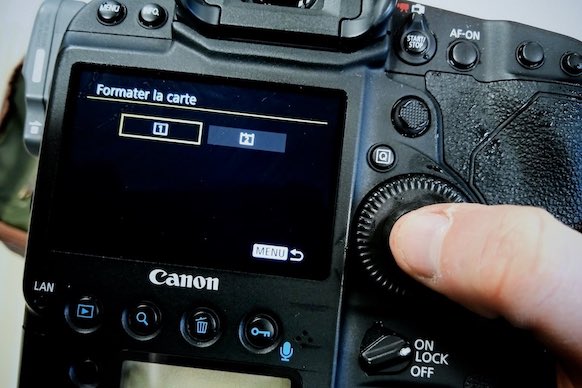
Recovering deleted photos
Accidentally deleting the contents of a memory card by formatting it can happen to anyone: don't panic [...]
My workflow with DxO and Photo Mechanic
Why I spend less than a minute (per photo) on post-processing my assignments [...]
Photographing sports
Sports photography is quite a challenging field to master. It requires [...]
Getting press accreditation
Press accreditation is the essential pass that allows you to photograph a concert, event [...]

Photographing a concert
Photographing a concert or show is relatively complex, but very rewarding [...]
Photographing a sunset
Photographing a sunset is a real treat for both the eyes and the photographer, impossible to [...]
10 tips for better photos
A few tips, in no particular order, to avoid common mistakes. The very first tip [...]
How to create a panning effect?
Essential for photographing motorsports such as rallies, F1 or [...]
Photography in the rain
As I live in Pas-de-Calais, I should have some expertise when it comes to answering this [...]
Photography basics
When taking a photograph, the photographer can adjust four parameters to compose and control [...]