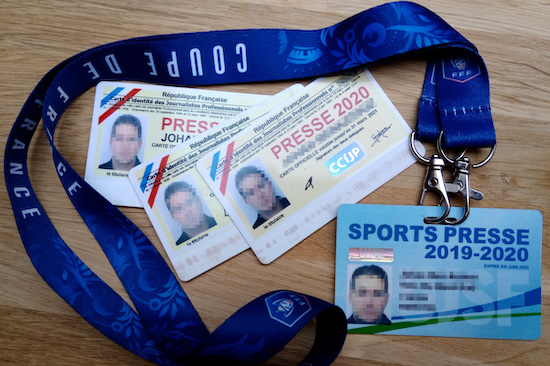
French press cards and Sports Presse card, allowing photographers in particular to cover professional football (Ligue 1, Ligue 2), basketball (Elite, Pro B), TOP 14 rugby, etc.

How to Get Press Accreditation or a Press Pass (last updated August 19, 2026)
Press accreditation is the pass issued by the press office (sports events) or by the organizer (concerts, shows, rallies) that allows you to photograph an event.
This article concerns the French system. For other countries, I am not qualified to advise you on the rules and procedures that apply there. Accreditation generally applies to important or medium-sized events: for a free concert in a small venue, you rarely need accreditation to take photographs. The same applies to an amateur football match on Sunday at your local municipal stadium.
The difficulty of obtaining accreditation varies greatly, because the importance of the event and the level of media coverage both matter. In general, you need legitimate professional credentials: you may be a photojournalist (and therefore a journalist with a press card), a press correspondent (often with a correspondent card issued by the newspaper you work for, although it has no legal status), a photographer working for a city or communications department (regional, departmental or intermunicipal), or possibly a photographer for a specialist website. For a concert or show, the organizer may authorize you to photograph an artist as part of media coverage, generally in exchange for an article or coverage in a media outlet. So, if you are attending purely as a private individual for fun, accreditation is unlikely... If you want to practise concert photography, look for small municipal concerts or small festivals.
French press cards and Sports Presse card, allowing photographers in particular to cover professional football (Ligue 1, Ligue 2), basketball (Elite, Pro B), TOP 14 rugby, etc.
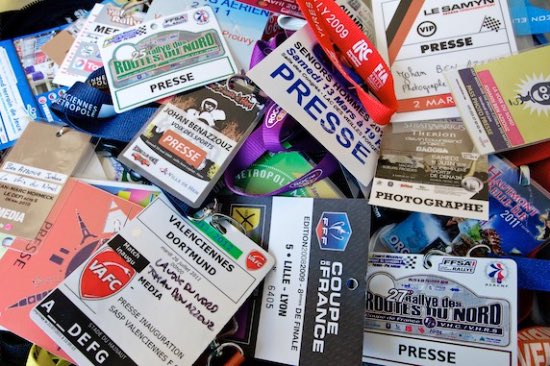
Examples of press accreditation badges for photographers: football, boxing, rallying, concerts, shows, etc. Badges that you may or may not keep — they make nice little souvenirs.
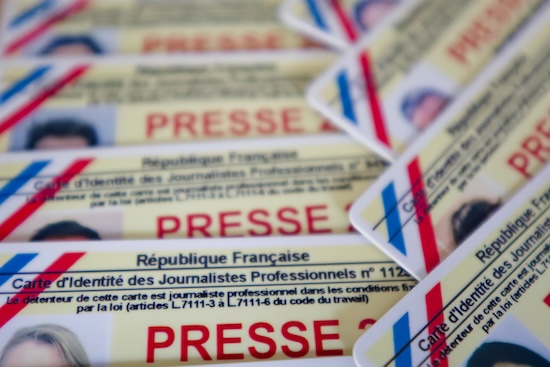
The French press card, issued by the Commission de la carte d'identité des journalistes professionnels (CCIJP), is valid for one year (from March 31 to March 31 of the following year).
Reserved for journalists, the press card is an official professional identity card that allows a press photographer to prove their status and gain easier access to events and press conferences. The card is issued by the Commission de la carte d'identité des journalistes professionnels (CCIJP) in Paris and must be renewed every year. To obtain it, you must be paid a salary by a newspaper or press agency, either as a staff employee or as a freelance journalist paid per assignment. In France, professional journalists must be remunerated as employees: the auto-entrepreneur system or remuneration through authors' rights AGESSA do not therefore allow someone to practise as a professional journalist under this framework. For a first press-card application, the CCIJP may nevertheless assess certain situations at the beginning of a career with some flexibility. It is therefore preferable to contact the CCIJP directly to find out which conditions apply to your situation. Practical information is available on the CCIJP website or on the SNJ website.
Once you have this valuable credential, accreditation requests become more straightforward and legitimate.
You may be wondering how to cover a Ligue 1 match. Well, having a press card is not enough! For French professional football, the UJSF Sports Presse card is required to submit an accreditation request, but it is not itself the accreditation for a match. Since the Covid-19 period, requests have been made match by match through the UJSF accreditation platform, including for Ligue 2 matches. A specific request must therefore be submitted for each match you wish to cover.
The Sports Presse card is an annual UJSF membership open to press-card holders. It provides access to the platform and allows accreditation requests to be submitted; approval remains dependent on each match and its access conditions.
There are nevertheless exceptions, particularly for some journalists on fixed-term contracts or freelancers who are starting out and have not yet received their press card. In such cases, the UJSF representative present at each match may, depending on the competition rules, issue temporary accreditation valid for one match.
In addition, at major sporting events (Champions League, Coupe de France final, World Cup, Roland-Garros, Olympic Games, etc.), it may also be necessary to submit a separate accreditation request to the organizer. Places can be very limited, and media outlets providing extensive coverage of the event may receive priority.
There is also another route into professional football: some independent photographers, often quite young and sometimes working for little or no pay, manage to obtain accreditation directly from professional clubs. This may be through a Media Club or a content-creation assignment for the club, or even for social media or the personal accounts of professional players. LFP media regulations do allow access for photographers accredited directly by the club or the LFP, but with an important condition: their work must be reserved for the club, the LFP, sponsors or relevant partners and cannot be supplied to the press or websites.
This route can therefore, in some cases, provide access to Ligue 1 or Ligue 2 stadiums without going through the traditional press route. But be careful: you should carefully consider what you are accepting in return. For some young photographers, these collaborations can involve very low-paid or unpaid work in exchange for stadium access and another line on the portfolio. In my view, it can be a possible way in, but you should remain realistic about the value of your work and avoid allowing access to the sidelines to justify unreasonable conditions.
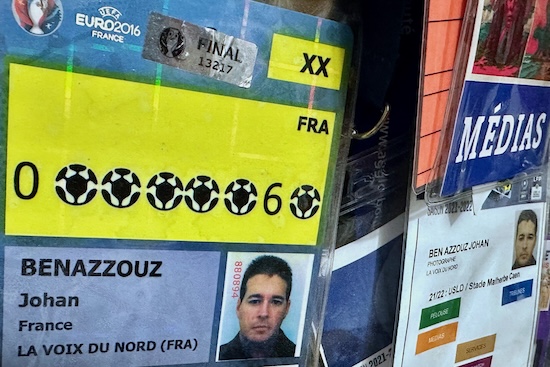
Accreditation for Euro 2016: in addition to general accreditation, photographers had to apply for each match, as well as the final, with the small gold “final” sticker. Priority was given to major news agencies (AFP, Reuters, AP). For photographers from the French regional daily press (PQR, such as La Voix du Nord), we had fewer of the available positions around the stadium. And that is understandable: the major agencies then distribute their production to many media outlets.
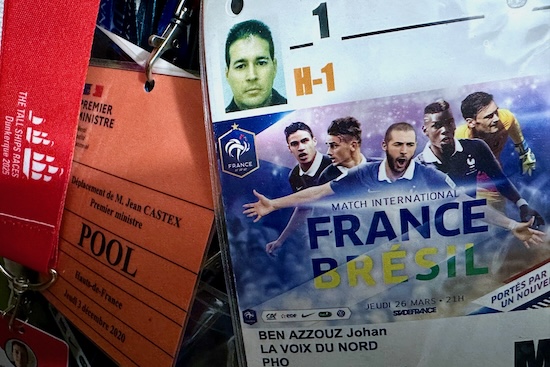
For French national football team matches, whether friendly or official, you must hold a press card and then submit an accreditation request. On the left is a “pool” accreditation. Because of the large number of media outlets and photographers, the press services of the Élysée Palace, the Prime Minister or prefectures may limit access to two or three professionals, generally a camera operator, a photographer and a writer, who then make their images available to other media outlets.
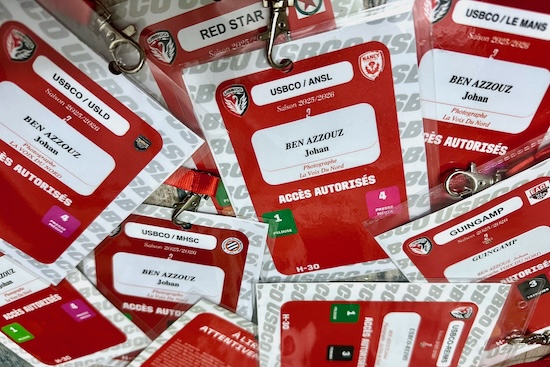
Since the post-Covid period, the Sports Presse card is no longer sufficient to cover a Ligue 2 or Ligue 1 season: you now have to apply for accreditation for every match! It is a fairly demanding procedure, since requests have to be submitted throughout the year. You therefore end up with dozens of accreditation badges, unlike those from a major competition that many people keep as souvenirs — at least, I do! These small accreditation badges at least leave a record of the matches covered.
Commonly used in France by the regional daily press (PQR), the local press correspondent covers local news for a newspaper within a limited geographical area (one or more neighbouring towns).
The CLP writes articles and often photographs the event themselves. A professional journalist then edits the text and may make changes if necessary. This status is defined by Law No. 87-39 of January 27, 1987, supplemented on January 27, 1993, and provides a way into the press: it is a good way to considerably expand your network, obtain accreditation more easily for events in your area, and supplement your income. The newspaper pays the CLP in fees and mileage expenses, and the CLP is considered self-employed: approximately €400 per month (15% of the annual Social Security ceiling) should not be exceeded in order to avoid social contributions.
Many newspapers issue a local press correspondent card: a small document bearing the CLP's photograph, first and last name, the newspaper logo, the words “local press correspondent”, the validity date and the signature of the agency manager.
It is not an “official” document, but it is often more than sufficient to cover a small local concert or festival and pass through security without difficulty.
If you have a good writing style and good photography skills, you can try contacting a newspaper newsroom near you to offer your services.
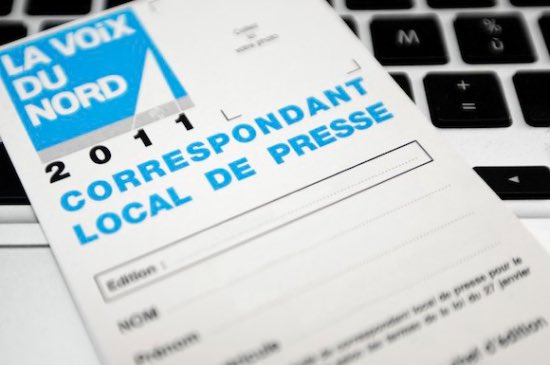
An old local press correspondent card from La Voix du Nord (CLP): in many local newspapers in France, CLPs can cover small events and demonstrate their legitimacy to organizers. It is often valid for one year, like the official press card.
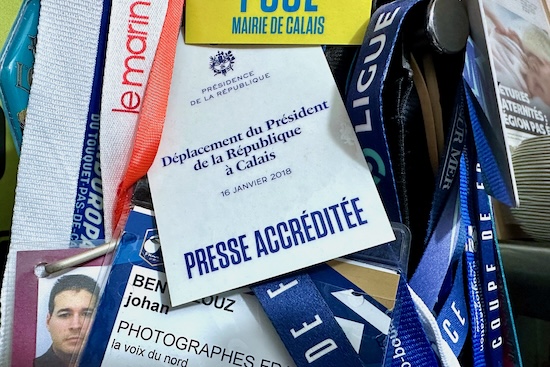
For political events, accreditation is also mandatory: rallies, visits by a minister or the President of the Republic. For the President, the Interior Minister or the Prime Minister, the bag and equipment are inspected by an explosive-detection dog accompanied by an Interior Ministry officer. This is the famous “security sweep”.
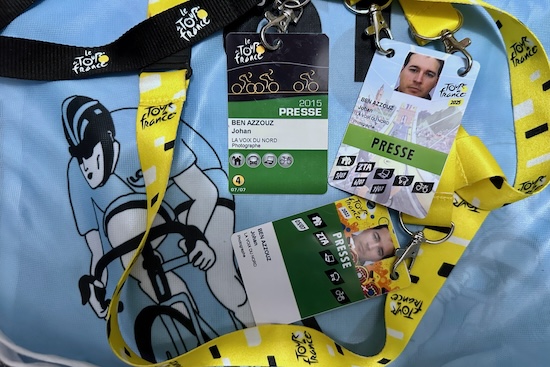
Here are several Tour de France accreditations: there is always a vest to wear, and its colour determines which areas you can access at the start, finish, etc. The good news is that to photograph the Tour, you can also simply stand by the roadside with the spectators, without accreditation.
For an amateur photographer or a non-journalist photographer, there is still an effective way to obtain accreditation for an event without a press or correspondent card: your network of contacts. This network will not allow you to photograph a professional sporting event such as a Ligue 1 match, but it can open the doors to a concert, festival, regional rally, air show, etc.
Get in touch with as many people as possible in the field you want to photograph, build relationships to expand your network, and... be patient!
One final tip for obtaining accreditation more or less easily: become the photographer (often as a volunteer) for an association or sports federation, or for a specialist website such as a “webzine”. It is a serious avenue to explore if you are just starting out.