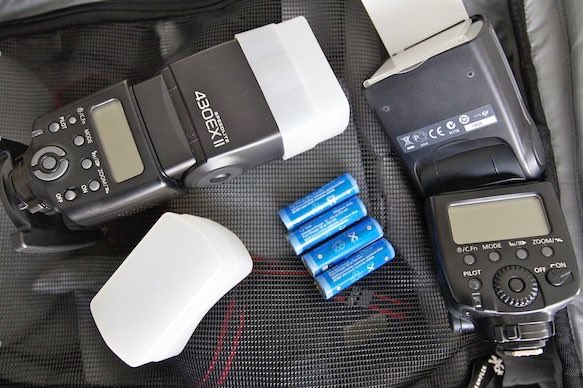
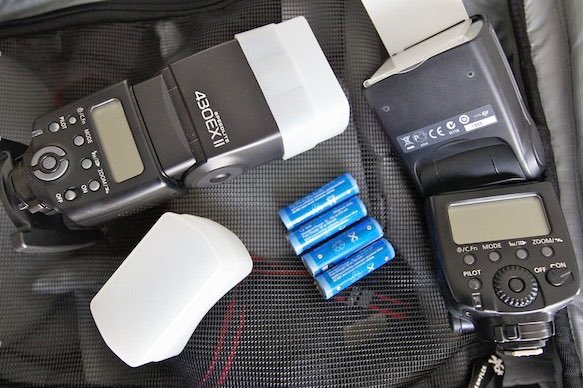
Canon 430 EX and 580 EX speedlights.

How to Choose a Speedlight? (last updated August 15, 2026)
A speedlight is far from essential for taking good photographs. Recent cameras can work at high ISO sensitivities and there are plenty of fast lenses. A flash is nevertheless useful when light is scarce, to lift shadows in bright sunlight, freeze movement or, above all, create your own light. Used for bounced lighting, for example by pointing the head at a ceiling or a light-coloured wall, it can produce a much more natural result than direct flash. Current speedlights also offer lithium-ion batteries on some models, radio control and high-speed sync, making them much more versatile than older models.
Canon 430 EX and 580 EX speedlights.
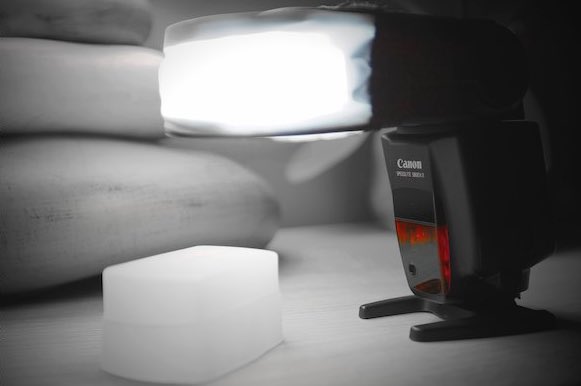
A diffuser mounted on a Canon 580EX II speedlight.
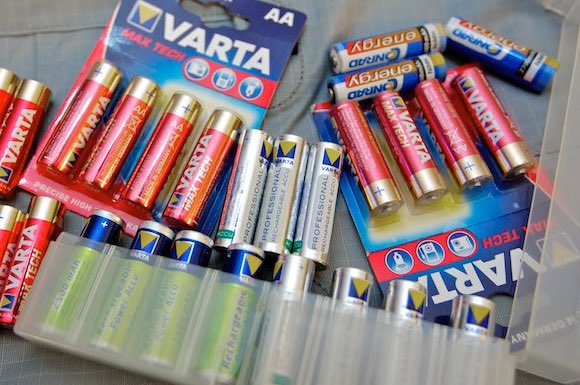
A speedlight is a major power consumer.
Flash power is described by the Guide Number (GN), a figure calculated at ISO 100 using the following formula:
GN = Aperture x distance (between the flash and the subject)
For example, a speedlight with a Guide Number of 60 at ISO 100 and with its head set to 200mm is significantly more powerful than a model with a Guide Number of 30. But be careful: the Guide Number also depends on the focal length used for the measurement, so it does not always allow a direct comparison between two models. In practice, TTL mode calculates the exposure automatically.
It is also worth noting that increasing ISO sensitivity increases the useful range of the flash. Simply remember that, all else being equal, the higher the Guide Number, the more powerful the flash.
Don't worry, this is all rather theoretical, and in practice you will rarely bother doing such calculations before taking a picture: the flash's TTL system does it for you! Simply remember that the higher the GN, the more powerful your flash.
Flash coverage determines the angle covered by the light. With a wide-angle lens, the flash head therefore needs to cover a sufficiently short focal length. Recent models generally have an automatic zoom head that adapts coverage to the focal length being used. Some also offer a built-in wide-angle diffuser for very short focal lengths. On modern mirrorless cameras, focal-length and exposure information is transmitted automatically to the flash when it is compatible with the camera system.
Some models allow the flash head to be tilted or swivelled towards a ceiling or wall. This is particularly useful for bounced flash, allowing you to achieve softer and more natural light.
This is the time needed for the flash to become ready again after firing. Recent models with lithium-ion batteries can offer very short recycle times, sometimes less than one second at full power. At reduced power, the flash can of course fire much more rapidly.
Interfaces have evolved considerably. Some speedlights now feature colour screens or simplified controls, while high-end models can be controlled remotely by radio from a transmitter or sometimes from the camera body. Ergonomics remain a personal matter, but the important thing is being able to quickly adjust power, TTL/manual mode and wireless groups.
Flash sync speed is the maximum shutter speed at which the camera can normally use a flash across the entire sensor area. It depends on the camera body and is often around 1/200 or 1/250 s. On recent cameras, high-speed sync (HSS) allows the flash to be used at faster shutter speeds, particularly to maintain a wide aperture in daylight.
HSS works by sending a rapid succession of flashes while the shutter curtain moves. Its main drawback is a loss of power and therefore a shorter range. Some recent systems also offer more advanced synchronization solutions, but compatibility depends on the camera body and the flash.
Speedlights have traditionally used four AA/R6 batteries. Many models still do, and rechargeable Ni-MH batteries remain an economical and practical solution. But recent high-end models increasingly use dedicated lithium-ion batteries, which generally provide faster recycling and longer battery life.
For occasional use, good-quality rechargeable AA batteries are more than sufficient. For intensive use, a lithium-ion battery can make a real difference. Some professional speedlights also accept external power supplies to further speed up recycling and increase battery life.
A diffuser or small light-shaping accessory can modify the flash light, but beware of marketing claims: a small diffuser attached directly to the head does not magically turn a hard light source into a large soft source. To genuinely soften the light, you mainly need to increase the apparent size of the source or use a ceiling or wall as a reflective surface.
The range has evolved considerably since the older Canon 430EX II, 580EX II and Nikon SB-910 models mentioned in the previous version of this page. In 2026, Canon offers the Speedlite EL-10, EL-5 and EL-1 version 2, while Nikon retains the SB-5000 among its high-end models. The third-party market has also become very interesting: Godox, for example, offers the V1Pro and V100 in versions compatible with Canon, Nikon, Sony, Fujifilm and OM SYSTEM. Profoto remains a higher-end reference with the A10.
I would therefore no longer recommend systematically avoiding third-party brands. Systems such as Godox now offer a genuine radio and multi-flash ecosystem, with products that are often very competitive. The key point is to choose the version compatible with your camera body and check which TTL, HSS and radio functions you actually need.
On the used market, older Canon Speedlite, Nikon Speedlight, Godox and other reputable brands can still be very good bargains. Above all, check the condition of the flash tube, tilting/swivelling head, contacts, battery or battery compartment, and compatibility with your camera body.
And personally?
I never use flash. This is absolutely not a universal rule: flash can be a fantastic tool for portraits, events, weddings, studio work, photojournalism or simply for taking control of difficult light. But it is not an essential accessory for taking good photographs, and in my own work as a photojournalist, I prefer to work with available light.
How to choose a lens?
The lens is the component that has the greatest impact on image sharpness [...]
How to choose a camera?
Today, the choice is mainly between mirrorless cameras and the used market [...]
How I photographed Napoleon during the solar eclipse?
An image like this does not happen by chance [...]

How I set up my camera
There is obviously no universal setting that works for every situation. The choices [...]
How to choose a camera bag
Finding the perfect camera bag to carry and protect your valuable equipment is [...]

How to choose a computer?
Clearly, in 2026, any recent laptop or desktop computer, whether PC or Mac, can [...]
How to choose a speedlight?
A speedlight is far from essential for taking good photographs. Recent cameras [...]
Photographing amateur football
For those getting started in sports photography, covering an amateur football match is a good choice [...]
Recovering deleted photos
Accidentally deleting the contents of a memory card by formatting it can happen to anyone: don't panic [...]
My workflow with DxO and Photo Mechanic
Why I spend less than a minute (per photo) on post-processing my assignments [...]
Photographing sports
Sports photography is quite a challenging field to master. It requires [...]
Getting press accreditation
Press accreditation is the essential pass that allows you to photograph a concert, event [...]

Photographing a concert
Photographing a concert or show is relatively complex, but very rewarding [...]
Photographing a sunset
Photographing a sunset is a real treat for both the eyes and the photographer, impossible to [...]
10 tips for better photos
A few tips, in no particular order, to avoid common mistakes. The very first tip [...]
How to create a panning effect?
Essential for photographing motorsports such as rallies, F1 or [...]
Photography in the rain
As I live in Pas-de-Calais, I should have some expertise when it comes to answering this [...]
Photography basics
When taking a photograph, the photographer can adjust four parameters to compose and control [...]